Your finance team gets invoices in many layouts. A tool that reads them well in a demo can still miss a subtotal when a supplier changes a template. One wrong number can reach your ERP before anyone notices.
Traditional OCR (software that turns a scanned page into text) works by matching patterns. It does well when every document looks the same. It struggles when layouts change.
What makes agentic OCR different from traditional OCR?
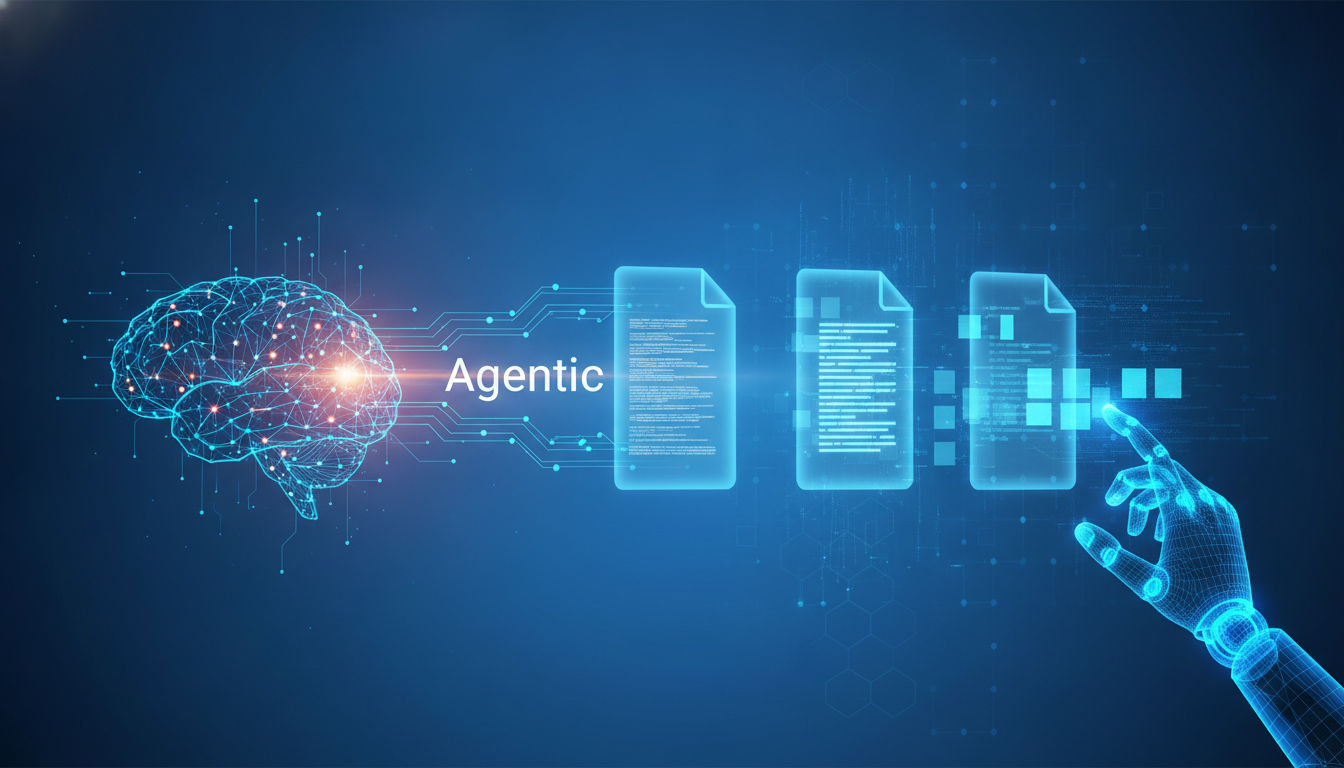
Agentic OCR adds a reasoning step. The AI works out what kind of document it has. It reads the layout, checks its own result and tries again if something looks wrong.
Old tools need someone to set up a template for each format. Agentic OCR can handle a new layout without that manual setup. Accuracy still needs to be tested on your own documents.
How does it improve document workflows?
It does more than read text. It checks the data against your business rules before the data moves on. For example, it can compare an invoice total with the purchase order and flag a mismatch for review.
This means people only look at the documents that need them. Errors are caught early, before they spread into other systems.
What are the key parts of agentic OCR?
- A reasoning model. An AI model that reads both text and images on the page.
- Visual grounding. Each extracted value links back to its exact spot on the document, so anyone can check it.
- Document type recognition. The system spots the document type on its own.
- A correction loop. The system rechecks its work and fixes errors before passing data on.
Where does it help most?
It helps where precision matters and documents vary. In legal work, it can pull out key clauses and point to the page each one came from. In healthcare, it can read medical forms. In financial services, it can check invoices and other financial documents as they arrive.
Why it is hard in production
A demo uses clean, chosen documents. Production brings scans at odd angles, new suppliers and missing fields. Finance teams also need to know why a match was approved.
So the hard questions are not about reading text. Who reviews a doubtful match? What gets logged? How does the team learn when the system is wrong?
How we approach it
We are forward-deployed engineers. We work inside your finance team, with the people who handle the invoices every day. We start with one workflow, such as matching invoices to purchase orders, and build it on your real documents.
We set a confidence level for each match. Above it, the agent can go ahead. Below it, a person reviews the case. Every decision goes into an audit trail, so you can see what was matched, when and why.
Then we hand over. Your team learns to run the agent, adjust the thresholds and read the results. Our process is built so that your team owns the system when we leave. For the reading step, we use document AI and OCR.
One example from our work: AI expense matching inside ERP for finance teams.
What to check before you go live
- Test on your own documents, including the messy ones.
- Set a clear confidence level that sends doubtful cases to a person.
- Keep a record of every decision.
- Link each value to its place on the source document.
- Name who owns the system after handover.
FAQ
What is the main difference between traditional OCR and agentic OCR?
Traditional OCR matches patterns and needs templates. Agentic OCR reasons about the document and adapts to new formats.
How does it handle errors?
It checks its own output and corrects errors before passing data on. Doubtful cases go to a person.
Can it work with our ERP or CRM?
Yes. It can connect to systems like these to feed checked data into your workflows.
Is it only for large enterprises?
No. Smaller firms can use it too, though the case is strongest where document volume is high.
Next step
If your team has invoice and document matching in pilot but not in production, book a discovery call.
Saksham Gupta
Founder & CEO, EduBildSaksham Gupta is the founder and CEO of EduBild, which embeds forward-deployed AI engineers with enterprise teams to ship production AI. Ex-Daimler AG; KIT Germany.


