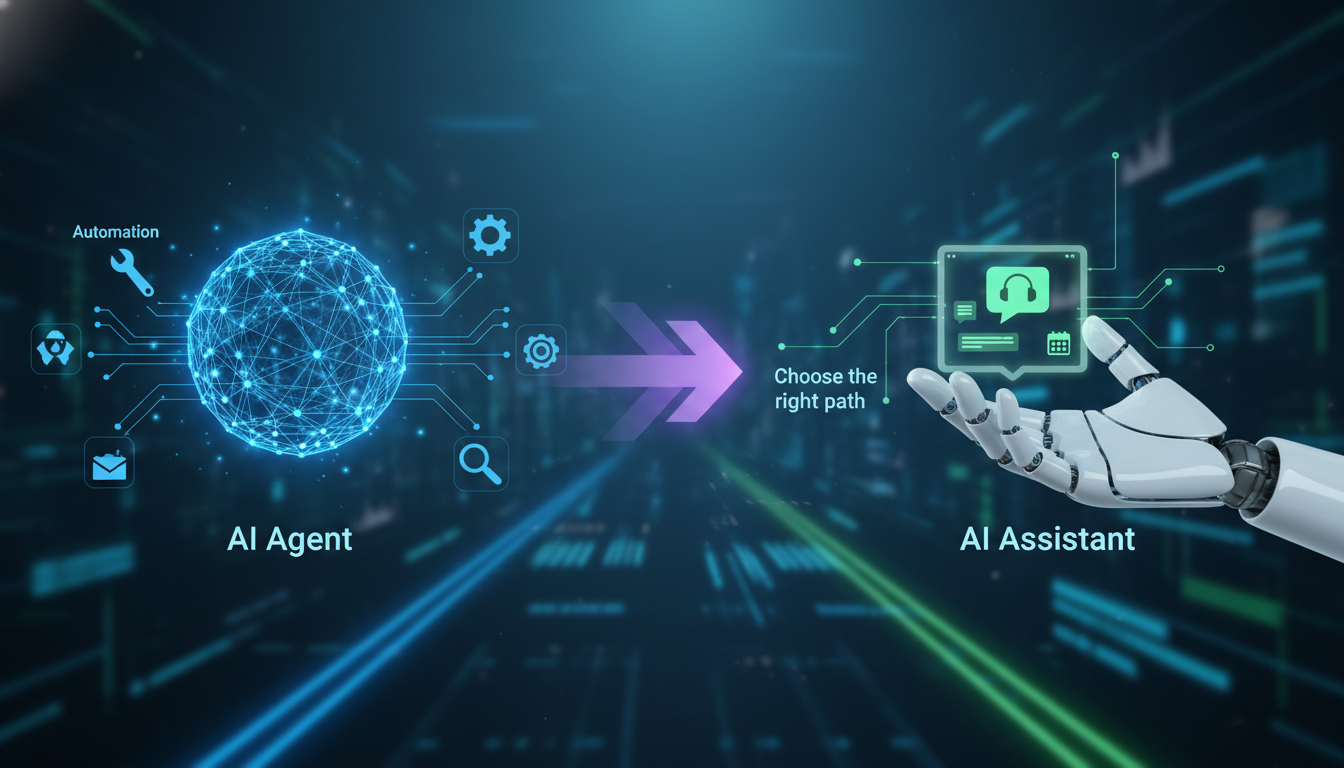
Leaders often hear "AI agents" and "AI assistants" used as if they mean the same thing. They do not. Both run on large language models (LLMs), the AI models behind tools like GPT, Claude and Gemini. But they do different jobs in your workflow. Picking the wrong one is a common reason a pilot never reaches production.
How they differ
An AI assistant works through conversation. You ask, it answers. It is good for writing, summarising and quick analysis. It helps one person with one task at a time.
An AI agent works toward a goal. It can read data, use tools, remember what it did and take several steps in a row. It does not only help with a task. It can finish the task.
Interaction versus action
An assistant waits for a prompt. It reacts to what a user types, inside one conversation.
An agent can start on its own. A system event or a schedule can trigger it. It can read a record in one system and update another. That is where the real workflow savings come from, and also where the real work begins.
Which one fits your use case
If you want to help individuals work faster, an assistant is often enough. It usually needs only a chat screen and a link to a language model through an API (a standard way for software to talk to software).
If a workflow crosses several systems, you need an agent. It must connect to your CRM, your ERP and other tools. That takes more effort, but it can run the whole workflow.
The hybrid pattern
Many enterprises use both. The assistant talks to the user and collects the details. The agent then does the work in the background. In customer service, an assistant can greet the customer. An agent can then process a refund or update the customer record.
How we approach it
Most agent pilots stall after the demo. The agent works on clean sample data. It then meets real systems, real access rules and real exceptions. Nobody on the team owns the next step.
We handle this by embedding forward-deployed AI engineers inside your team. They build and ship the agent with your people, in your systems. They stay through the move to production, then hand it over. You can see the steps on our process page, and the build side on our AI agents page.
One example from our work: An autonomous L1 IT support agent that resolves 70% of tickets without a human, around the clock.
Takeaways
- Use an assistant when the goal is to help a person with a task.
- Use an agent when the work spans systems and should run without a person.
- Combine them when users need a conversation and the back office needs action.
- Plan for production early: system access, exceptions, review and handover.
Next step
If your team has an AI agent working in pilot but not in production, book a discovery call.
Saksham Gupta
Founder & CEO, EduBildSaksham Gupta is the founder and CEO of EduBild, which embeds forward-deployed AI engineers with enterprise teams to ship production AI. Ex-Daimler AG; KIT Germany.


