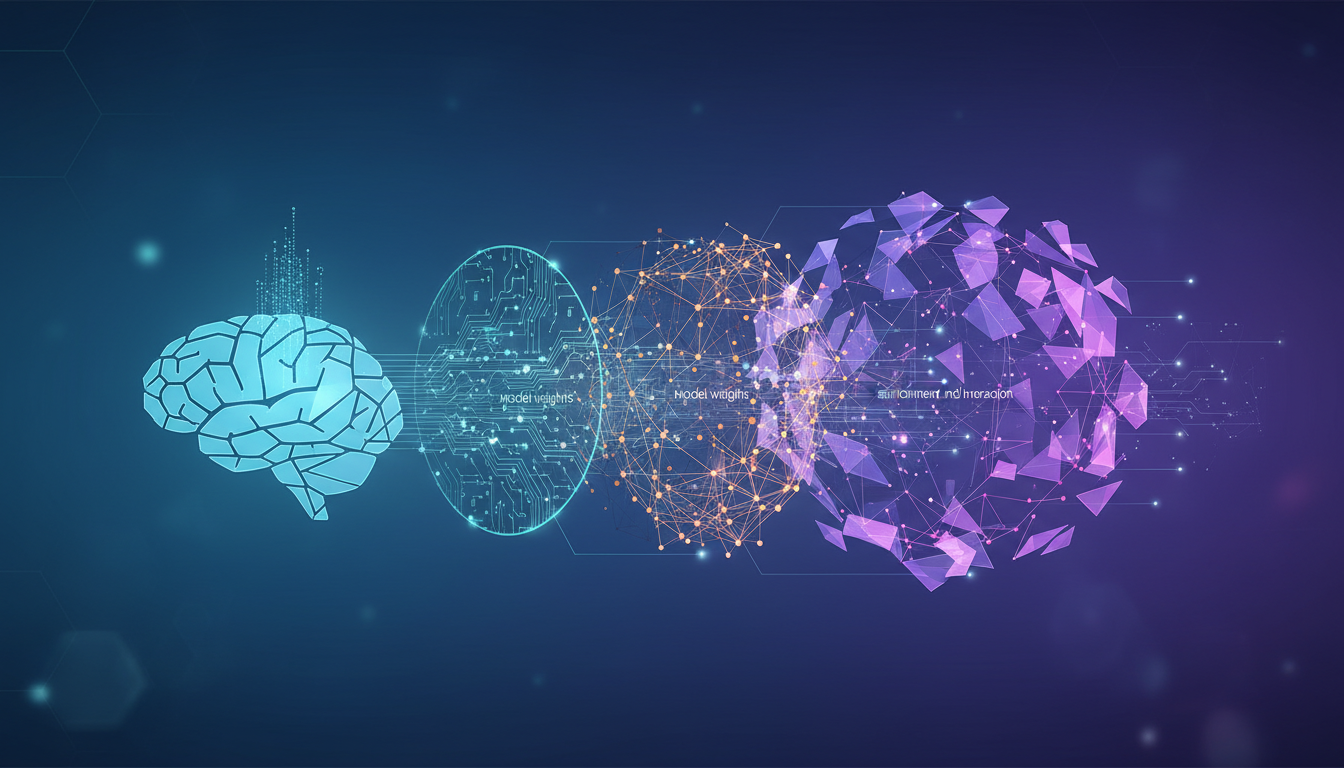
Continual learning means an AI agent gets better over time without starting again. Most people think this means retraining the model. For agents in production, learning happens in three places: the model, the harness and the context.
Knowing which layer to change helps your team improve an agent faster, with less risk and lower cost.
The Three Layers of Agentic Systems
An agent is more than a model. It is the model plus the code around it plus the information it can see. Learning can happen in each part.
Model
The model layer is the AI model itself. Updating it means changing its weights, the numbers inside the model that shape its answers.
Two common methods are used. Supervised fine-tuning (SFT) trains the model on examples of good answers. Reinforcement learning (RL) rewards the model for good results. One RL method is Group Relative Policy Optimization (GRPO).
The main risk is catastrophic forgetting. This is when training on new data makes the model worse at older tasks. Most models are trained once for the whole agent. In theory, you could train a separate model for each user, but that costs more to run and manage.
Harness
The harness is the code and instructions around the model. It decides how the agent takes on a task, which steps it follows and how it talks to users.
Teams can improve the harness by running the agent on many tasks and reading its logs. They then change the code where the agent went wrong. Research on end-to-end harness tuning, such as Meta-Harness, is growing. Most teams tune one harness for the whole agent, though user-specific harnesses are possible.
Context
The context layer is what the agent is told and can use. This includes instructions, skills, tools and saved memory. It works like the agent's notes.
Context can be set for the whole agent, or for one user, team or organisation. Some agents keep a plain file of notes and update it over time. Updates can be made offline or live. The user can ask for them, or the agent can make them on its own.
Why This Is Hard in Production
In a demo, one layer is enough. In production, each layer has its own risk.
- Model changes are slow and costly. They can also break things that worked before.
- Harness changes affect every user at once. A bad change spreads fast.
- Context changes are quick and cheap. But an agent that rewrites its own notes can learn the wrong thing, and no one may notice.
The Role of Traces
A trace is a log of what an agent did, step by step. Traces feed all three layers. They show where the agent failed, which examples to train on, which code to fix and which notes to add.
Without traces, you cannot tell whether a change helped. Keep them, and review them with the people who own the workflow.
How We Approach It
At EduBild, we embed forward-deployed AI engineers inside your team. We build the agent, ship it and then hand it over. Learning is part of that handover, not an extra.
For most production agents, we start with context and the harness. They are cheaper to change, easier to test and easy to roll back. We use AI agents built this way, with traces switched on from day one.
We turn to the model layer only when the evidence calls for it. That is when traces show the same gap again and again. Then we look at fine-tuning, and we test it against the older tasks to catch forgetting. Our process keeps a person in charge of every change that reaches users.
What It Means for Business Leaders
- Ask which layer a team is changing, and why. "We retrained it" is not always the right answer.
- Start with the cheapest layer that fixes the problem.
- Require traces and a way to undo any change.
- Decide who approves what an agent is allowed to learn.
- Plan for your own team to run this after handover.
Next step
If your team has an agent that needs to keep improving in pilot but not in production, book a discovery call.
Saksham Gupta
Founder & CEO, EduBildSaksham Gupta is the founder and CEO of EduBild, which embeds forward-deployed AI engineers with enterprise teams to ship production AI. Ex-Daimler AG; KIT Germany.


