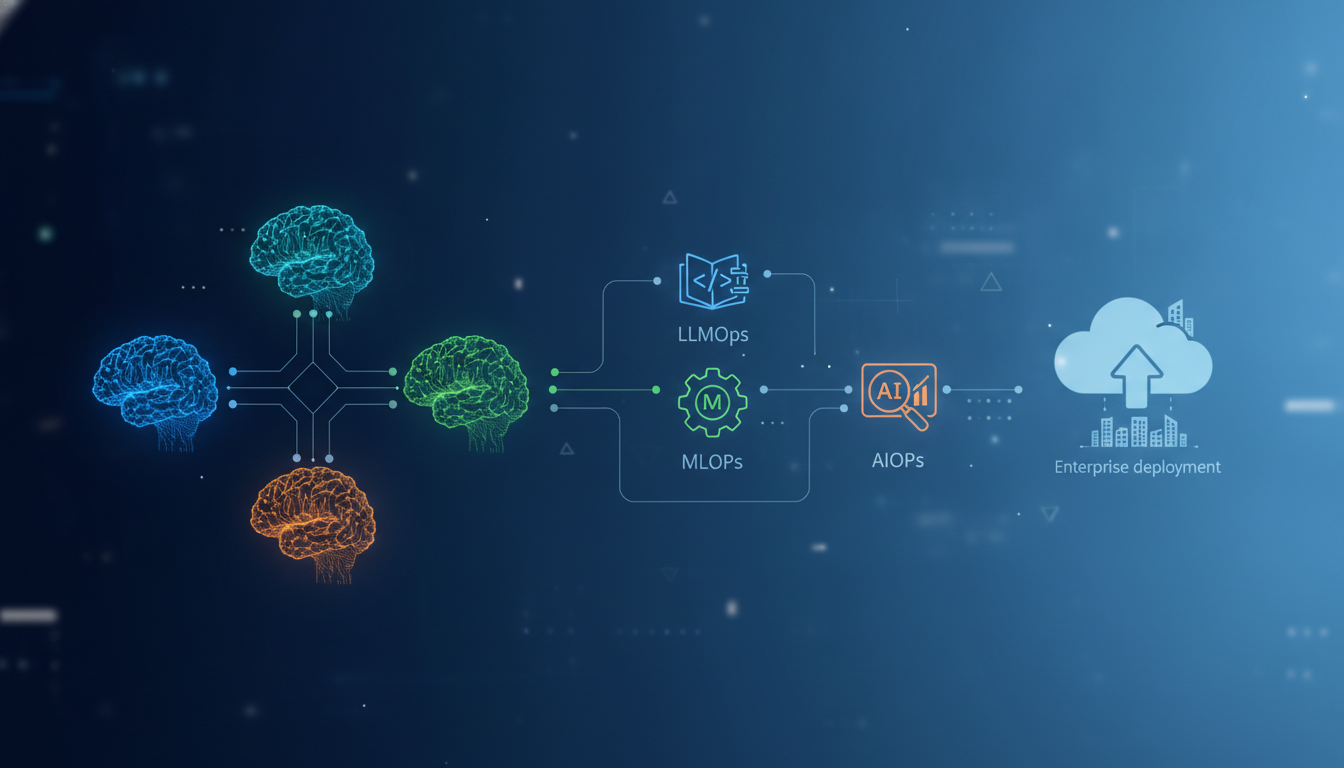
In the rapidly evolving landscape of enterprise AI, choosing the right operational framework is pivotal for scalability and efficiency. Enterprises often grapple with deciding between LLMOps, MLOps, and AIOps, each catering to distinct AI workloads and business needs. Selecting the wrong framework can lead to inefficiencies, governance issues, and increased operational risks, especially as AI adoption expands in India’s burgeoning enterprise sector.
For scalable AI deployment, understanding the roles of LLMOps, MLOps, and AIOps is crucial. MLOps focuses on streamlining the lifecycle of traditional machine learning models, which is ideal for predictive analytics and fraud detection. LLMOps extends MLOps principles to manage large language models (LLMs) and generative AI applications, essential for AI copilots and chatbots. AIOps applies AI to automate IT operations, improving infrastructure reliability and incident management. Enterprises often benefit from integrating these frameworks based on their specific AI maturity and business objectives.
What are the key differences between LLMOps, MLOps, and AIOps?
Though LLMOps, MLOps, and AIOps share common principles such as automation and governance, they cater to different AI workloads and stakeholders.
| Criteria | MLOps | LLMOps | AIOps |
|---|---|---|---|
| Primary Goal | Operationalize ML models | Operationalize LLMs & Generative AI | Automate IT operations |
| AI Workloads | Predictive models | Foundation models, GenAI | IT infrastructure |
| Primary Users | Data Scientists, ML Engineers | AI Engineers, Platform Teams | IT Operations, SRE, DevOps |
| Data Type | Structured & Semi-structured | Text, documents, knowledge bases | Logs, metrics, events |
| Monitoring Focus | Model performance & drift | Response quality, hallucinations, token usage | Infrastructure health & incidents |
Understanding these differences helps enterprises align their AI strategy with the right operational framework, ensuring efficient deployment and management of AI systems.
When should enterprises choose LLMOps?
LLMOps is ideal for enterprises leveraging large language models and generative AI applications. This framework is particularly beneficial for deploying AI copilots, chatbots, and intelligent document search tools. In India, where enterprises are increasingly adopting AI for customer support and knowledge management, LLMOps can significantly enhance user experiences by ensuring secure, scalable, and governed deployments.
For instance, implementing Retrieval-Augmented Generation (RAG) systems through LLMOps can improve the accuracy and relevance of AI-generated content by integrating external knowledge sources. This is crucial for enterprises aiming to enhance their customer interaction processes.
Why is MLOps crucial for predictive analytics?
MLOps is essential for enterprises focused on predictive analytics, enabling them to automate model training, deployment, monitoring, and retraining. This framework supports use cases such as demand forecasting, fraud detection, and recommendation engines. In India, where data-driven decision-making is becoming a norm, MLOps facilitates scalable, governed ML workflows that improve collaboration between data science and engineering teams.
For example, Mohan Impex's ERP development illustrates how MLOps can streamline predictive analytics processes, enhancing operational efficiency and decision-making.
How does AIOps enhance IT operations?
AIOps is designed to automate IT operations, making it ideal for infrastructure monitoring, incident management, and root cause analysis. In enterprises where IT reliability is critical, AIOps helps reduce downtime and improve operational efficiency through intelligent automation. This is particularly relevant for Indian enterprises managing complex IT environments, where prompt incident response is essential.
By deploying AI agents for IT operations, enterprises can achieve higher operational resilience, ensuring that their infrastructure supports seamless business operations.
What this means for your organization
Choosing between LLMOps, MLOps, and AIOps requires a clear understanding of your organization’s AI workload and business goals. For enterprises in India, integrating these frameworks can lead to substantial improvements in AI deployment and operational efficiency. By assessing the specific needs of each AI initiative, organizations can adopt a tailored approach that maximizes both performance and governance.
For instance, an enterprise might implement on-premise LLM deployment to maintain data privacy while leveraging LLMOps for generative AI applications. Similarly, combining MLOps and AIOps can optimize both predictive analytics and IT operations, ensuring a robust AI infrastructure.
FAQ
Can enterprises use all three frameworks together? Yes, enterprises often benefit from combining LLMOps, MLOps, and AIOps based on their AI maturity and business objectives. This integrated approach allows for comprehensive management of diverse AI workloads.
What is the primary benefit of LLMOps over MLOps? LLMOps extends MLOps by addressing the unique requirements of large language models and generative AI applications, such as prompt management and RAG, which are not typically covered by MLOps.
Is AIOps suitable for small enterprises? While AIOps can benefit any enterprise with IT operations, its advantages are more pronounced in larger organizations with complex infrastructures. However, smaller enterprises can still leverage AIOps for enhanced IT efficiency.
To discuss how these frameworks can be tailored to your enterprise needs, contact us.
Saksham Gupta
Founder & CEOSaksham Gupta is the Co-Founder and Technology lead at Edubild. With extensive experience in enterprise AI, LLM systems, and B2B integration, he writes about the practical side of building AI products that work in production. Connect with him on LinkedIn for more insights on AI engineering and enterprise technology.