In the rapidly evolving landscape of AI, enterprises face significant challenges in managing the infrastructure costs associated with deploying large language models (LLMs). The financial burden can be immense, as seen with OpenAI's estimated $14 billion operational costs for ChatGPT in 2026. For companies looking to scale AI solutions efficiently, optimizing infrastructure costs is paramount.
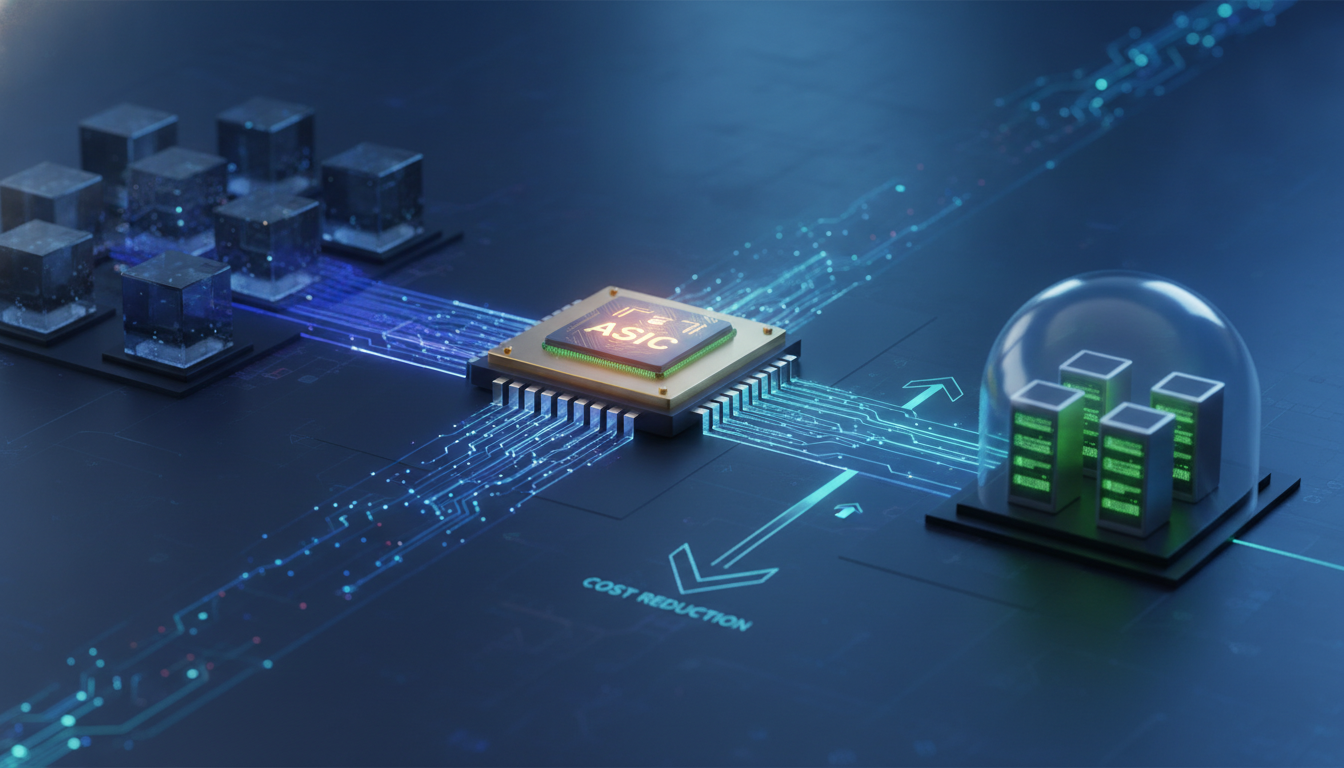
Custom ASIC solutions offer a viable path to reducing these costs. By designing hardware specifically for LLM inference, enterprises can achieve greater efficiency and lower operational expenses. Custom chips, like OpenAI's Jalapeño, minimize data movement and optimize the balance between compute, memory, and networking resources, thus addressing the bottlenecks of traditional AI hardware. This approach not only lowers costs but also enhances model performance, creating a more responsive user experience.
Why Choose Custom ASIC Solutions for LLMs?
Custom ASIC solutions are tailored specifically for the unique demands of LLMs, unlike general-purpose GPUs. This specialization allows for significant cost savings. For example, OpenAI's Jalapeño chip is designed to minimize data movement, which is a major cost driver in AI operations. By optimizing the architecture to focus on inference tasks, ASICs reduce energy consumption and increase throughput, leading to lower overall costs.
Moreover, custom ASICs enable tighter integration with existing infrastructure. This vertical integration, akin to Apple's hardware-software synergy, allows enterprises to streamline their AI pipelines, from chip architecture to application layers. This holistic approach not only reduces costs but also enhances the scalability of AI solutions, a critical factor for enterprise growth.
How Does Custom Silicon Impact Operational Efficiency?
The implementation of custom silicon, such as the Jalapeño chip, significantly boosts operational efficiency. By focusing on LLM inference, these chips optimize the use of computational resources, reducing the need for expensive, high-margin third-party hardware. OpenAI's approach, for example, involves integrating Broadcom’s networking silicon, allowing for efficient communication across data centers.
This efficiency is reflected in the reduced energy requirements and enhanced processing speeds. For enterprises, this means not only cost savings but also the ability to deploy more complex models without a proportional increase in infrastructure costs. As a result, businesses can offer more responsive AI services, leading to improved customer satisfaction and retention.
What Are the Trade-offs of Custom ASIC Solutions?
While custom ASIC solutions offer numerous benefits, they also come with certain trade-offs. The initial investment in designing and manufacturing custom chips can be substantial. However, this is often offset by the long-term savings in operational costs.
Another consideration is the time and expertise required to develop these solutions. Companies must have a clear understanding of their AI workloads and the specific demands of their LLMs to design effective ASICs. This requires collaboration with hardware partners and a deep integration of AI and hardware teams, which can be a resource-intensive process.
How Does the India Market Benefit from Custom ASIC Solutions?
In India, where enterprises are increasingly adopting AI technologies, custom ASIC solutions can provide a competitive edge. The cost-sensitive nature of the Indian market makes the efficiency gains from ASICs particularly attractive. By reducing the operational costs of AI deployments, Indian companies can allocate more resources towards innovation and expansion.
Furthermore, the use of custom silicon can help Indian enterprises overcome the challenges of scalability and energy efficiency, which are critical in a country with a rapidly growing digital economy. By leveraging these technologies, Indian businesses can enhance their AI capabilities while maintaining cost-effectiveness.
What This Means for Your Organization
For organizations considering the adoption of LLMs, the shift to custom ASIC solutions can be transformative. By optimizing infrastructure costs, businesses can deploy AI models more efficiently and at a lower cost. This not only improves the bottom line but also allows for greater flexibility in AI strategy.
To successfully implement custom ASICs, companies should evaluate their specific AI needs and collaborate with experienced partners in hardware design and integration. At EduBild, we offer expertise in deploying on-premise LLM solutions and fine-tuning LLM fine-tuning to ensure that your AI infrastructure is both cost-effective and high-performing.
FAQ
What are the main benefits of using custom ASICs for LLMs?
Custom ASICs are designed specifically for LLM inference, allowing for optimized performance and reduced costs. They minimize data movement and improve energy efficiency, making them a cost-effective solution for large-scale AI deployments.
How do custom ASICs compare to traditional GPUs in AI applications?
While GPUs are versatile and widely used, custom ASICs offer superior efficiency for specific AI tasks like LLM inference. They are tailored to the unique requirements of these models, resulting in better performance and lower operational expenses.
Are custom ASIC solutions suitable for all enterprises?
Custom ASICs are most beneficial for enterprises with large-scale AI operations. While the initial investment is higher, the long-term cost savings and performance improvements make them a worthwhile consideration for companies looking to scale their AI capabilities.
Ready to optimize your AI infrastructure? Contact us at EduBild to explore how custom ASIC solutions can benefit your enterprise.
Saksham Gupta
Founder & CEO, EduBildSaksham Gupta is the founder and CEO of EduBild, which embeds forward-deployed AI engineers with enterprise teams to ship production AI. Ex-Daimler AG; KIT Germany.