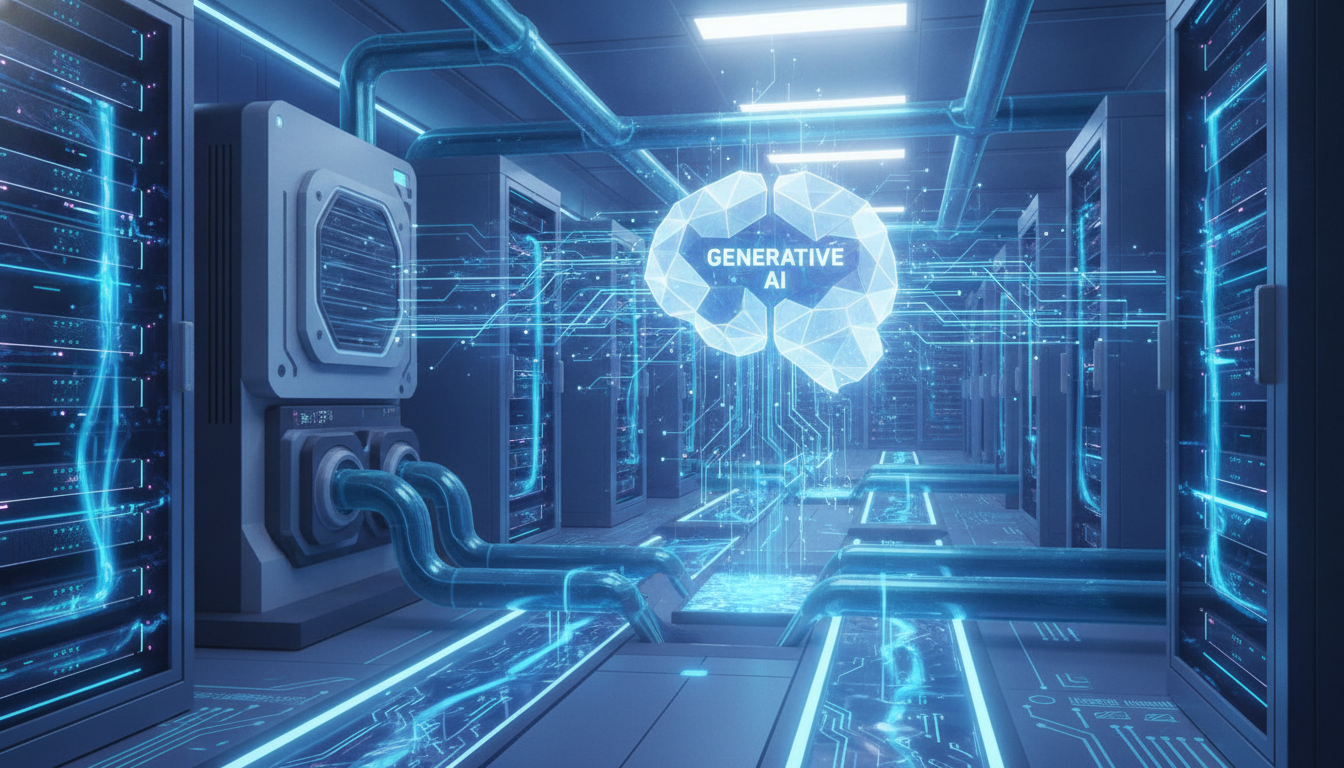
In today's hyper-competitive enterprise landscape, efficiently managing AI workloads is a critical challenge for technical leaders. With increasing computational demands and energy costs, optimizing data centers for AI has become a priority. Traditional air-cooled systems often struggle with the thermal load imposed by modern AI processors, leading to inefficiencies and increased operating costs.
For those looking to optimize data centers for generative AI workloads, integrated liquid cooling solutions offer a compelling option. By directly cooling the CPU and GPU, liquid cooling can reduce temperatures by up to 11%, thereby improving hardware performance and reliability. This approach also cuts server power consumption by up to 30%, allowing enterprises to scale AI workloads effectively while maintaining operational predictability and reducing energy expenses.
How does liquid cooling enhance AI workload efficiency?
Liquid cooling systems, like those offered by JetCool, utilize SmartPlate technology to directly manage heat at the chip level. This method is significantly more efficient than conventional air cooling, particularly for AI models requiring high-density computing resources. For instance, the liquid-cooled Dell PowerEdge XE7745 can handle sustained loads of up to 8 kilowatts (kW) per server, supporting dual 5th Gen AMD EPYC processors and up to eight NVIDIA RTX PRO 6000 Blackwell GPUs.
By reducing CPU temperatures by up to 7% and GPU temperatures by up to 11%, liquid cooling systems allow for more stable performance under heavy loads. This is crucial for generative AI applications, which often require prolonged high-intensity processing. The reduction in temperature not only enhances performance but also extends the lifespan of the hardware, providing further cost efficiency.
What are the power consumption benefits?
Integrated liquid cooling solutions can significantly lower server power consumption. By reducing the need for high-speed fans, these systems decrease fan power usage by up to 50% and reduce fan speeds by as much as 70%. Consequently, total server power consumption can be cut by up to 30% compared to traditional air-cooled systems.
This power efficiency translates into tangible cost savings for enterprises. Lower energy consumption means reduced electricity bills, and the decreased need for cooling infrastructure can lead to savings in capital expenditure. For Indian enterprises, where energy costs can be a significant factor, this efficiency can provide a competitive edge.
How does liquid cooling affect data center acoustics?
Another often-overlooked advantage of liquid cooling is the reduction in noise levels. JetCool's systems reportedly cut acoustic output by up to 23 decibels, which represents an approximately 80% reduction in perceived server noise. This quieter operation can improve the working environment in data centers, making them more pleasant for staff and reducing auditory distractions.
What are the scalability implications?
Scalability is a key consideration for any enterprise deploying AI solutions. JetCool’s liquid-cooled systems provide a streamlined path for scaling compute-intensive workloads. With a single provider handling hardware, cooling, and services, enterprises can minimize deployment risks and focus on scaling their AI infrastructure.
For organizations in India, where the demand for AI-powered solutions is growing, such integrated solutions offer a reliable means to expand data center capabilities without incurring significant additional risk. JetCool’s global manufacturing footprint and supply chain capabilities further ensure that enterprises can deploy and scale these platforms across multiple data centers and regions.
What this means for your organization
Adopting integrated liquid cooling solutions can significantly enhance the efficiency and scalability of AI workloads in your data center. By lowering temperatures and power consumption, these systems not only improve performance but also reduce operational costs. This is particularly beneficial for enterprises in India, where energy efficiency can translate into substantial financial savings.
Furthermore, the reduction in noise levels and the ability to scale efficiently across multiple locations make these solutions an attractive proposition for forward-thinking organizations. By opting for a unified service provider like JetCool, enterprises can ensure a smooth transition to high-density AI infrastructure, backed by a single point of accountability.
FAQ
What is direct-to-chip cooling? Direct-to-chip cooling involves removing heat directly from the CPU and GPU chips using liquid cooling technology. This method is more efficient than traditional air cooling, improving performance and reliability.
How does liquid cooling reduce power consumption? By eliminating the need for excessive fan usage, liquid cooling systems lower fan speeds and power consumption, reducing overall server energy use by up to 30%.
Is liquid cooling suitable for Indian enterprises? Yes, liquid cooling is particularly advantageous for Indian enterprises due to its energy efficiency and scalability, which can lead to significant cost savings and operational improvements.
Ready to optimize your data center for AI? Contact us to discuss how EduBild can help implement these solutions.
Saksham Gupta
Founder & CEO, EduBildSaksham Gupta is the founder and CEO of EduBild, which embeds forward-deployed AI engineers with enterprise teams to ship production AI. Ex-Daimler AG; KIT Germany.