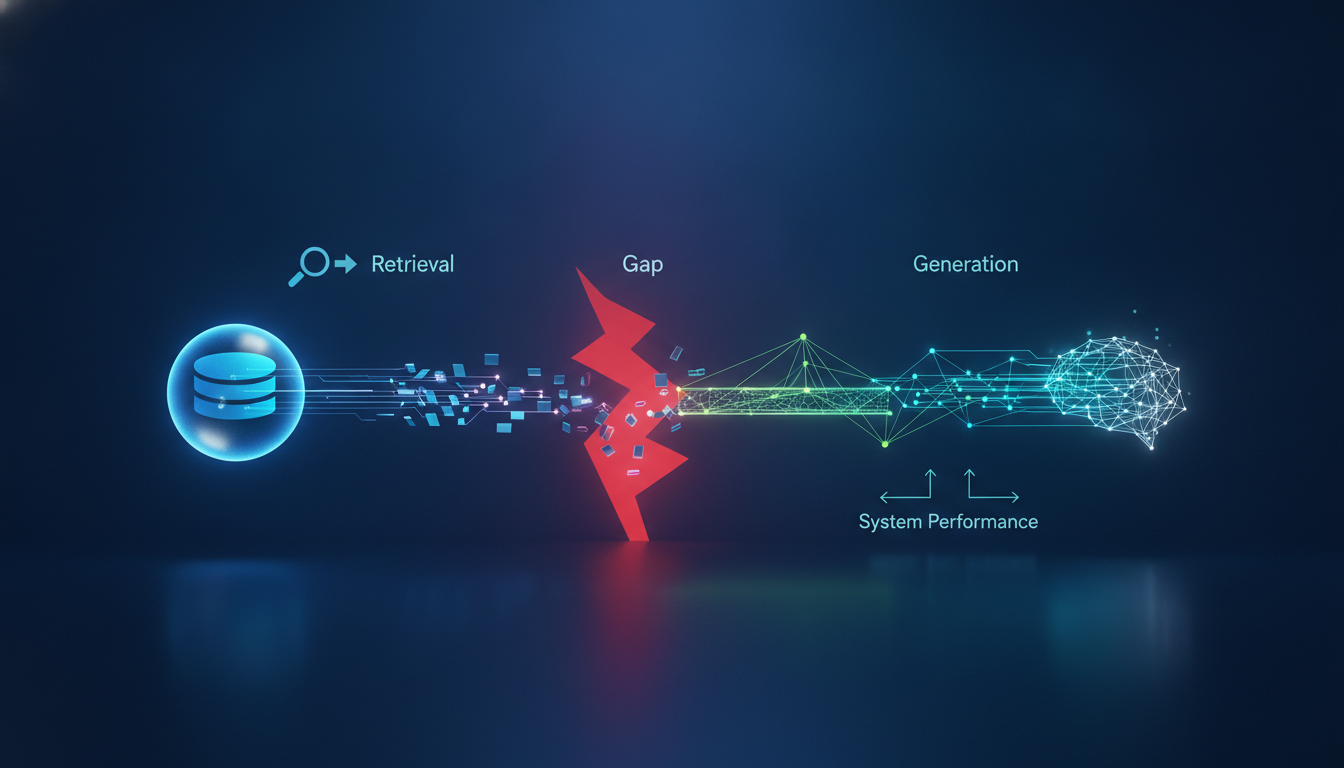
Retrieval-augmented generation (RAG) is a way of building AI that looks up your documents before it answers. Many RAG systems work well at launch. Months later, the answers get vaguer or wrong. The cause is often a gap between the two halves of the system: finding the right text (retrieval) and writing the answer (generation). We call this the retrieval-generation gap.
Teams usually spend their time tuning the answer-writing step. The finding step gets less attention. When search quality slips, the AI writes fluent answers from the wrong text. The fix is to measure both halves, not only the final answer.
How does retrieval precision affect RAG quality?
Retrieval precision asks one question. Of the passages the system pulled up, how many were the right ones? If precision is low, the AI answers from the wrong material. It may then invent details to fill the gaps.
To track this, build a small set of real questions with the correct source passages marked by your own experts. Run it on a schedule. Compare what the system retrieves against the marked passages. Also check recall, which asks whether the system found all the passages it needed. A drop in either one is an early warning.
One example from our work:
RAG search for a national statistics ministry: questions in Hindi, English and Kannada, by voice or text, with citations that link to the exact source page. 490+ legacy statistical tables indexed and queryable in plain language.
In work like this, every answer must point back to a source page. That makes retrieval quality easy to check, because a reviewer can open the cited page and see if it fits.
Why does chunk fragmentation happen over time?
RAG systems cut documents into small pieces, called chunks, so they can be searched. At first, each chunk covers one clear idea. Then people edit the documents and add new sections. The old cut points no longer fit. A chunk may now start mid-thought or end before the key sentence.
The system then returns half an answer. It looks relevant, but it is incomplete. To catch this, run a simple check on chunks every time you re-index. Flag chunks that are very short, cut off mid-sentence, or missing their heading. Fix the cutting rules, then rebuild the index.
What is vector index drift?
A vector index stores each chunk as a list of numbers that captures its meaning. The AI searches by comparing these numbers. If you change the model that creates the numbers, or add a new kind of document, old and new entries no longer match well. Search results slowly get worse. We call this index drift.
Three habits help. Record which model version built each index. When you change the model, rebuild the whole index, not part of it. And watch what people ask. If the topics of questions shift, test whether search still works for them.
How can you stop fake citations in agentic RAG?
Agentic RAG lets the AI decide how to search. It may run several searches, pick tools, and combine the results. This can improve answers. It also adds a risk: the system may cite a source that does not support its claim, or does not exist.
Add a check after the answer is written. For each citation, confirm that the source exists. Then confirm the cited passage backs the claim. If it does not, hold the answer back or send it to a person. RAG systems built for production include this kind of check from the start.
How we approach it
We are forward-deployed engineers. That means we work inside your team, not beside it. We sit with the people who use the system and read the questions they ask. We look at the answers that went wrong. This shows us which half of the system is failing, search or answer.
Then we build the checks into the system with your engineers. These include the test question set, the re-index checks, the citation checks and a simple dashboard. Your team sees the same numbers we do, and can switch a team or feature off if quality drops.
At the end, we hand it over. Your people learn to run the tests, read the dashboard and rebuild the index. You do not need us on call to keep quality steady. You can read more about our process.
What this means for enterprise teams running AI in production
A RAG system is not finished at launch. It changes as your documents, models and questions change. Treat it like any other business system. Give it an owner, a set of quality measures and a regular review. Decide in advance what happens when quality falls: who is told, and what gets paused.
Some teams also need to keep data inside their own network, or adapt a model to their own wording. Options such as on-premise LLM deployment and LLM fine-tuning can help here. Pick them for a clear reason, and measure the result against your test questions.
Next step
If your team has answer quality that slips after launch in pilot but not in production, book a discovery call.
Saksham Gupta
Founder & CEO, EduBildSaksham Gupta is the founder and CEO of EduBild, which embeds forward-deployed AI engineers with enterprise teams to ship production AI. Ex-Daimler AG; KIT Germany.