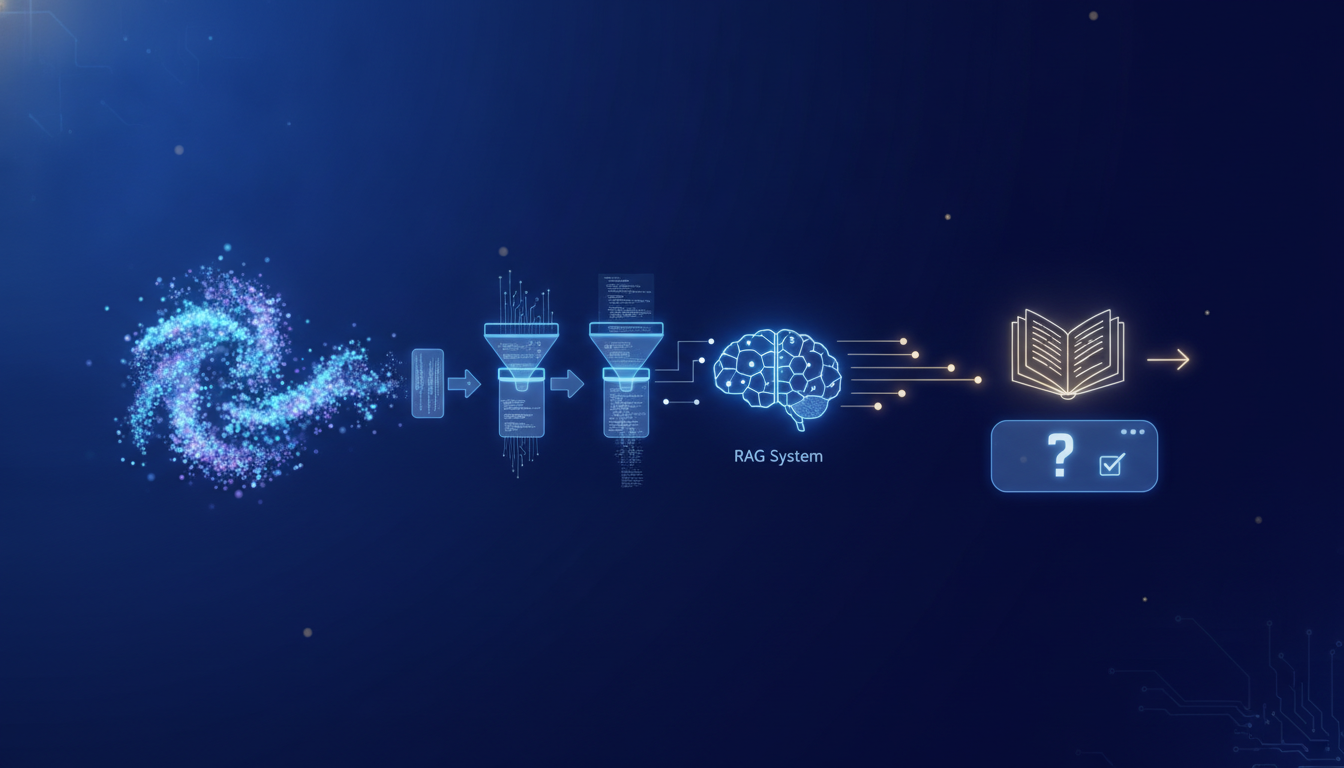
Many enterprise teams see AI answers that cannot be trusted. The cause is often weak retrieval in a retrieval-augmented generation (RAG) system. RAG means the AI looks up your documents before it answers. If it looks up the wrong pages, the answer will be wrong too.
Better retrieval makes answers more accurate and more relevant. Teams can get there by choosing a better embedding model, which turns text into numbers so the system can find similar passages. They can also split documents into better chunks and keep the index fresh. The index is the searchable copy of your documents. Together, these steps ground answers in real sources and cut down hallucinations, which are answers that sound right but are false.
Why is retrieval quality so important for RAG?
RAG links a language model to your own knowledge base. The model then answers from current, relevant material. When retrieval fails, the model falls back on what it learned in training. That is when it makes things up. In an enterprise, people may act on those answers, so the risk is real.
One example from our work: RAG search for a national statistics ministry: questions in Hindi, English and Kannada, by voice or text, with citations that link to the exact source page. 490+ legacy statistical tables indexed and queryable in plain language.
Citations like these let a reader check every answer against its source. That is what makes retrieval quality easy to see and easy to test.
How does retrieval failure lead to hallucinations?
Retrieval can fail in a few common ways. The first is drift. The system returns passages that look similar to the question but do not answer it. This often happens with questions that need facts from several documents.
The second is truncation. The model can only read a limited amount of text at once. If the retrieved text is too long, the end is cut off and key facts are lost.
The third is stale results. Old information keeps ranking high in search. This hurts most when your data changes often, such as policies, prices lists or support articles.
What can you improve in retrieval?
Start with the embedding model. A general model works for broad questions. A model tuned to your field often does better on specialist text, such as legal or medical documents.
Next, look at chunking. Good chunks follow the natural breaks in a document. Each chunk should make sense on its own. Then keep the index up to date, so old material does not outrank new material.
Why a bigger model is not the fix
Some teams think a larger model will make up for weak retrieval. It will not. A larger model gives more fluent wrong answers, but it cannot fix poor input.
In our experience, a smaller model with strong retrieval often beats a larger model with weak retrieval. It is also usually cheaper to run. So fix the lookup step first, then judge whether you need more model power.
How we approach it
We place forward-deployed AI engineers inside your team. They work with the people who know your documents and your workflow. Together we test retrieval on real questions from your business, not on a clean demo set.
We build the checks into the system from the start. We measure whether the right source was found, and we show citations so reviewers can verify answers. When retrieval is weak, we fix it before we change anything else. You can read more about our RAG systems work.
Then we hand over. Your team learns how to test, tune and update the system, so it keeps working after we leave. Our process covers each step.
What this means for enterprise teams running AI in production
In production, retrieval quality is not a one-time task. Documents change, users ask new questions, and answers drift. Your team needs a way to see when quality drops. That means regular tests on real questions, a review step when the system is unsure, and a clear owner for the index.
Treat retrieval as part of daily operations, like any other business system. Benchmark it often, update the knowledge base, and revisit chunking when the content changes. This protects your ROI and keeps trust high with the people who use the answers.
FAQ
What is a RAG system? It joins a language model to your own documents. The system finds the relevant passages first, then the model writes an answer from them.
How do you improve retrieval quality? Pick a suitable embedding model, split documents into sensible chunks, and keep the index current.
Can retrieval quality affect model performance? Yes. The model can only be as good as the text it is given. Poor retrieval leads to wrong and unreliable answers.
Why not just use a larger LLM? A larger model cannot fix bad input. It may only make wrong answers sound more convincing.
Next step
If your team has unreliable RAG answers in pilot but not in production, book a discovery call.
Saksham Gupta
Founder & CEO, EduBildSaksham Gupta is the founder and CEO of EduBild, which embeds forward-deployed AI engineers with enterprise teams to ship production AI. Ex-Daimler AG; KIT Germany.