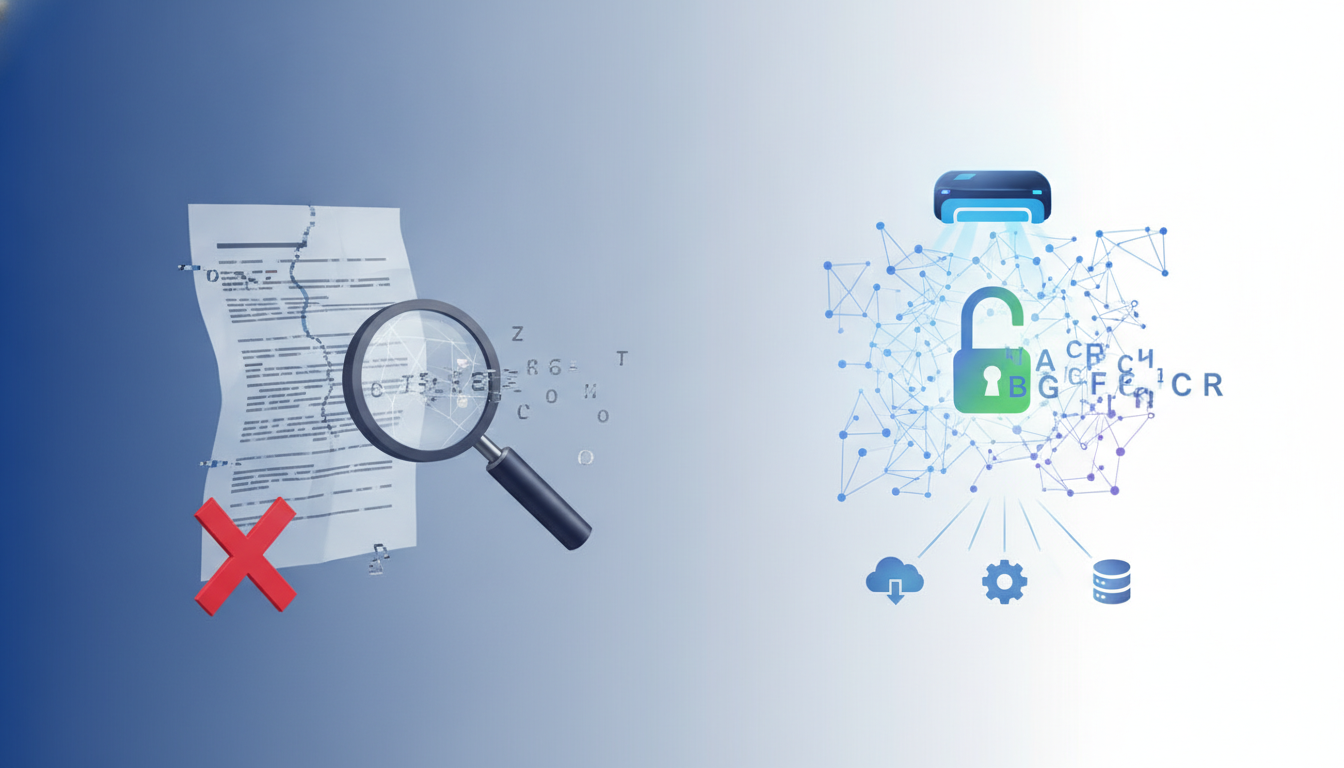
Your team scans invoices, contracts and reports. You expect the data to flow into your systems. Instead, someone retypes it by hand.
Basic OCR (optical character recognition, software that turns a picture of text into real text) often fails on scanned PDFs. The text comes out, but it is jumbled. That blocks automation and creates errors.
Basic OCR struggles with complex layouts, multiple columns and tables. The output is often unusable. Document AI reads a page's structure as well as its characters. It can fix much of this.
What are the limits of traditional OCR?
Traditional OCR works well on simple pages. It reads one character at a time. It does not understand how the page is built.
This matters most with columns, tables and charts. In a financial report, basic OCR may merge two columns into one stream of text. It may break a table or skip an embedded image. A person can read the text, but a system cannot use it.
It also struggles with handwriting, stamps and pages that mix languages. The result is errors or nonsense. Staff then correct the output by hand. That adds time and cost.
Why is layout such a problem in production?
Basic OCR treats a page as a flat grid of characters. It ignores where text sits and how parts relate. A long contract with footnotes, headers and tables needs more than character reading.
Without layout understanding, text comes out in the wrong order. Data entry cannot be automated safely. In finance, a wrong figure in the wrong row is a real risk.
A demo with ten clean pages hides this. Production brings thousands of messy scans, odd formats and poor image quality. That is where many pilots stall.
How we approach it
We embed forward-deployed AI engineers inside your team. They sit with the people who handle these documents every day. We start with discovery: which documents, which fields, and what a wrong answer costs you.
Next we prove it on your real scans, not sample files. Then we embed the extraction into your workflow and scale it to more document types. Throughout, we build document AI and OCR that reads layout as well as text.
We add production controls from the start. The system gives a confidence score for each field. Anything below a set threshold goes to a person for review. Every extraction keeps an audit trail, a record of what was read and who approved it. Each team can switch the agent on or off. Where documents are sensitive, we can use on-premise deployment, which keeps data inside your own systems. At the end, we hand over the system and train your people to run it. See our process.
An example from our work
One example from our work: AI expense matching inside ERP for finance teams.
The lesson is the same for scanned PDFs. The AI does the first pass. People check what is unclear. The workflow stays inside the systems your team already uses.
What should you check before you start?
- List your most common document types and their hardest features, such as tables or mixed languages.
- Test on your own scans, including the poor ones.
- Set a confidence threshold and decide who reviews what falls below it.
- Check how the output connects to your ERP and other systems.
- Choose where the system runs, on-premise or in the cloud, to fit your data policies.
- Plan the handover so your team can run and improve it.
FAQ
What is the difference between traditional and advanced OCR? Traditional OCR only recognises characters. Advanced systems also read the page layout, so text comes out in the right order.
Why does layout matter? It keeps text in the correct order and context. That is needed for accurate data.
Can advanced systems read handwriting? They often do better than traditional OCR. Results depend on the documents, so test on your own samples and send doubtful fields to a person.
Where can document AI run? On-premise or in the cloud. On-premise gives more control over data. Cloud is easier to scale.
Next step
If your team has scanned-PDF extraction in pilot but not in production, book a discovery call.
Saksham Gupta
Founder & CEO, EduBildSaksham Gupta is the founder and CEO of EduBild, which embeds forward-deployed AI engineers with enterprise teams to ship production AI. Ex-Daimler AG; KIT Germany.


