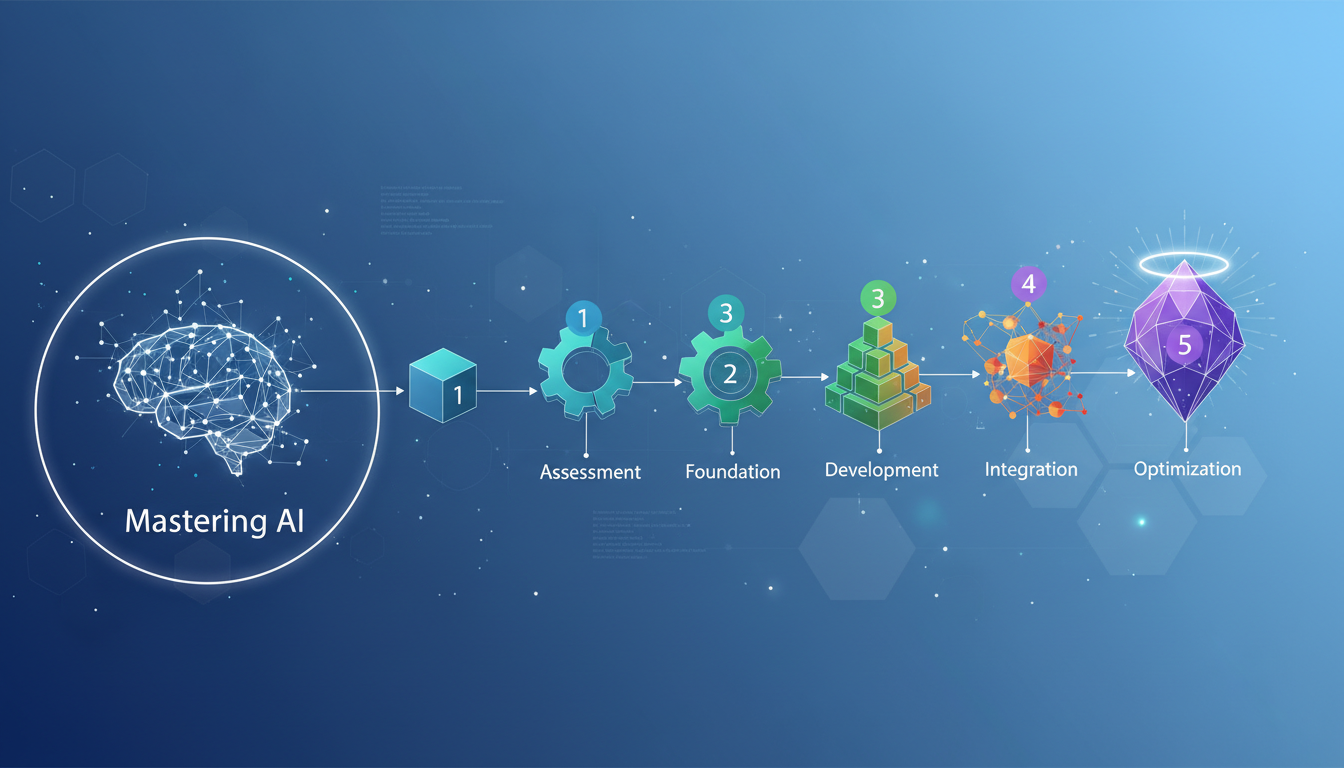
Many enterprises now run AI pilots. Far fewer have AI working in daily operations. The gap is rarely about the model. It is about data, ownership and the work of putting AI into real workflows.
A readiness model helps you see where you stand. This post walks through five stages and shows where pilots usually stall.
Understanding the AI readiness model
An AI readiness model is a simple map of your progress. It shows what you have in place today and what you need next. It is not only about owning AI tools. It is about whether those tools can run reliably, stay under control and serve a business goal.
Most stalled pilots share the same causes. The data is not ready, no one owns the result, and the pilot never connects to a real workflow. We see this pattern often.
The five stages of AI readiness
Stage 1: Awareness and foundation
Teams start to see what AI could do. Efforts are scattered and there is no clear plan. Typical signs:
- Exploration without a structured plan
- Little backing from senior leaders
- No rules yet for how AI may be used
To move on, clean up your data basics and link each AI idea to a business goal.
Stage 2: Pilots and capability building
Teams run small pilots in single departments, such as operations or customer support. They hire or train people and write first rules for use.
The risk is that every team builds its own thing. Without shared ownership, pilots stay in silos and are hard to scale. This is where most pilots stall.
Stage 3: Putting AI into operations
This is the turning point. AI moves from a demo into daily work. Typical signs:
- AI sits inside real workflows, not beside them
- Models are tracked and updated in a repeatable way
- Data lives on shared platforms
Success here depends on reliability. Someone must own the agent when it makes a mistake at 2 a.m.
Stage 4: Enterprise-scale adoption
AI now helps with decisions across many teams. The focus moves to results and cost. Typical signs:
- Business and technology teams work from the same goals
- AI performance is watched all the time
- Teams can switch AI on or off and review its output
Stage 5: AI agents run end-to-end work
At this stage, AI agents handle whole workflows with people reviewing the hard cases. Agents are software that can take steps on their own, such as looking up a record or closing a ticket. Humans step in when the agent is not confident.
Where does your enterprise sit?
Score yourself on five areas: data, technology, governance, people and business fit. Then:
- Score each area honestly, using real examples.
- Find the bottleneck. It is often data quality or unclear ownership.
- Fix the gaps with the biggest impact first.
How we approach it
We do not hand over a maturity score and leave. EduBild embeds forward-deployed AI engineers inside your team. They work next to your people to build, ship and scale production AI agents. You can see the steps on our process page.
We start by picking one workflow with a clear business payoff. We prove it in a small scope, then embed it into daily work. Then we scale it to other teams. Our AI agents work follows this path.
The last step matters most. We hand over the system, the documents and the skills, so your team can run it without us. One example from our work: An autonomous L1 IT support agent that resolves 70% of tickets without a human, around the clock.
Next step
If your team has AI agents stuck at the pilot stage in pilot but not in production, book a discovery call.
Saksham Gupta
Founder & CEO, EduBildSaksham Gupta is the founder and CEO of EduBild, which embeds forward-deployed AI engineers with enterprise teams to ship production AI. Ex-Daimler AG; KIT Germany.


