Why separate data matters in RAG systems
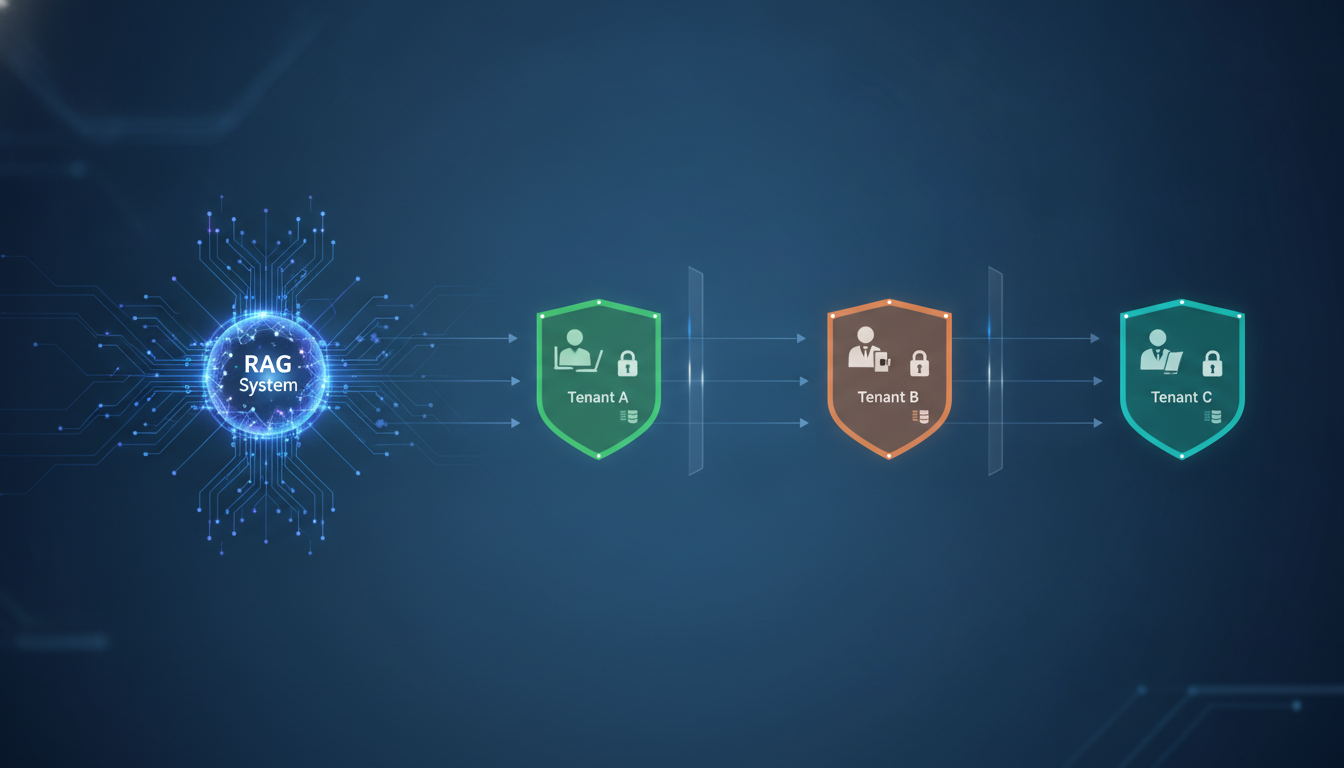
Data security matters a great deal in enterprise AI. Many organisations worry that sensitive data could reach people who should not see it. Multi-tenancy is one way to address this. It lets many teams or users share one system while each sees only its own data.
We will focus on retrieval-augmented generation (RAG), where the AI looks up your documents before it answers. In a shared RAG system, each document is tagged with who owns it. The system then checks those tags on every search. This keeps each user's data private and lowers the risk of a data leak.
How does multi-tenancy work in RAG systems?
Each document gets a label when it is added. The label says which user or team the document belongs to. When someone asks a question, the search step filters by that label first. Only then does the AI see any text.
This needs care in two places. At indexing, the step where documents are stored for search, every document must get the right label. At query time, the filter must always run, with no way around it.
One example from our work: RAG search for a national statistics ministry: questions in Hindi, English and Kannada, by voice or text, with citations that link to the exact source page. 490+ legacy statistical tables indexed and queryable in plain language. Learn more about our RAG systems.
What are the technical requirements?
First, you need a reliable way to manage labels. Documents must be read, labelled and stored the same way every time. This is the job of the ingestion pipeline, the steps that bring documents into the system.
Second, the search engine must filter by label on every request. A first-response agent that answers customers is a good case. It must only draw on the data it is allowed to use for that customer. Explore our AI agent solutions.
Challenges in production
The first challenge is growth. As more users join, the system holds more labels and handles more searches. It must stay fast.
The second challenge is testing. Data separation must be checked again and again. A single gap can expose data and damage trust in the system. A demo rarely shows this. Production does.
How multi-tenancy helps enterprises
Separating user data lowers the chance of unauthorised access. It also helps your team show who could see what.
Teams can also share one set of infrastructure while keeping data private. That can lower cost and make the system easier to run.
Implementation considerations
There is a trade-off. Stronger separation adds more design and management work. Plan for skilled people to run it, and for regular updates as needs change.
Some teams prefer to keep everything inside their own network. See our on-premise LLM deployment for that option.
What this means for teams running AI in production
Data separation is not a feature you add at the end. If a pilot skips it, the pilot often cannot go live, because security reviewers will stop it. Build the labels, filters and tests in from the start. Add a way to switch the system on or off for each team, and keep logs of who searched for what. These steps make a security review easier to pass.
How we approach it
We are forward-deployed engineers. That means we work inside your team, not beside it. We sit with your security, data and business owners and agree who may see which documents before we write code.
We then build the labels, filters and checks together with your engineers, and test them against real access rules. We ship in stages so your reviewers see results early.
At the end, we hand over. Your team gets the design, the tests and the know-how to run the system without us.
FAQ
What is the main benefit of multi-tenancy in RAG?
Each user's data stays private. Only the right people can see it.
Does it slow the system down?
A well-designed system can stay fast if labels and searches are managed well.
Can we add it to an existing RAG system?
Often yes. The indexing and search steps usually need changes.
Next step
If your team has data separation for RAG in pilot but not in production, book a discovery call.
Saksham Gupta
Founder & CEO, EduBildSaksham Gupta is the founder and CEO of EduBild, which embeds forward-deployed AI engineers with enterprise teams to ship production AI. Ex-Daimler AG; KIT Germany.