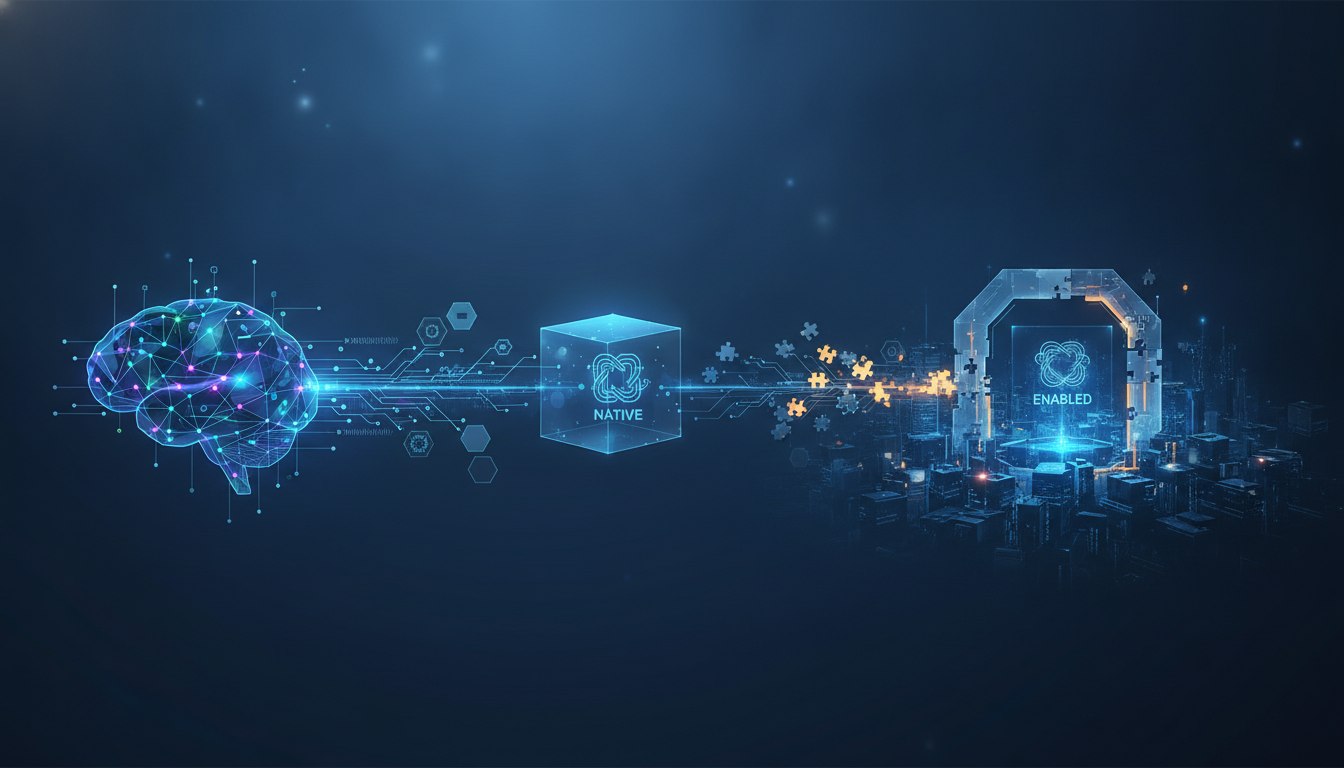
Many leaders ask whether to add AI to existing software or build new software around AI. The first is called AI-enabled. The second is called AI-native. The choice matters, but it is only part of the story. Many pilots stall because of how the work gets done, not which label the product has.
Understanding AI-Enabled Applications
AI-enabled applications add AI features to software you already run. Examples are forecasts, chatbots or automated steps. The core of the software stays the same.
The main advantage is lower risk. You can improve old systems without replacing them. You can adopt AI step by step, with little disruption to daily work.
The limits show up as you grow. The old design restricts what the AI can do. Adding more AI features gets harder over time.
Understanding AI-Native Applications
AI-native applications are built around AI from day one. Large language models (LLMs), the AI systems that read and write text, sit at the centre of how the product works. The design lets the system learn from feedback and improve.
These systems can handle large volumes of data and complex workflows. Their data approach is different too. They are built to collect feedback and get better with use.
The cost is higher at the start. You need skilled people, the right infrastructure and more build time. Weigh these against the long-term gain.
Key Differences
Role of AI: In AI-enabled software, AI improves existing features. In AI-native software, AI is the core capability.
Architecture: AI-enabled software is traditional software with AI added. AI-native software is designed around AI.
Learning: AI-enabled features learn little. AI-native systems are built to keep learning.
Scale: Old systems often limit AI-enabled software. AI-native software is built to grow.
Speed: AI-enabled software usually ships faster. AI-native software costs more upfront and may pay back later.
Real-World Examples
Take customer relationship management (CRM) software. An AI-enabled CRM adds a chatbot to the current product. An AI-native CRM is designed around AI that predicts what customers need.
In healthcare, an AI-enabled tool might suggest diagnoses from past data. An AI-native tool might keep learning from each new case.
Build, Buy or Embed
The real choice for most enterprises is wider than native versus enabled. You can build with your own team. You can buy a product. Or you can embed outside engineers inside your team to build and ship with you.
Many organizations start by adding AI to existing systems. As confidence grows, they build more AI-native parts. The right path depends on your AI maturity, your people and your goals.
How We Approach It
We see the same pattern often. A pilot works in a demo, then stalls. Nobody owns the move to production. The data is messy, the review steps are unclear, and the team that built it moves on.
At EduBild, we embed forward-deployed AI engineers inside your team. They work on your real workflows, ship agents into production, and then hand them over. Your people learn the system as we build it. You can see this in our process.
Whether the result is AI-enabled or AI-native is a design choice we make with you. Often we start by adding AI agents to a workflow you already run. We then grow from there once it pays off.
Steps to Move Toward AI-Native
Assess what you have: List your systems and find where AI can add clear value.
Build skills: Hire or train people who can guide the work, or embed engineers who teach as they build.
Work in small steps: Ship small pieces and adjust based on real feedback.
Plan your data: Set clear rules for how data is stored, checked and reused.
Next step
If your team has an AI build-or-buy decision in pilot but not in production, book a discovery call.
Saksham Gupta
Founder & CEO, EduBildSaksham Gupta is the founder and CEO of EduBild, which embeds forward-deployed AI engineers with enterprise teams to ship production AI. Ex-Daimler AG; KIT Germany.


