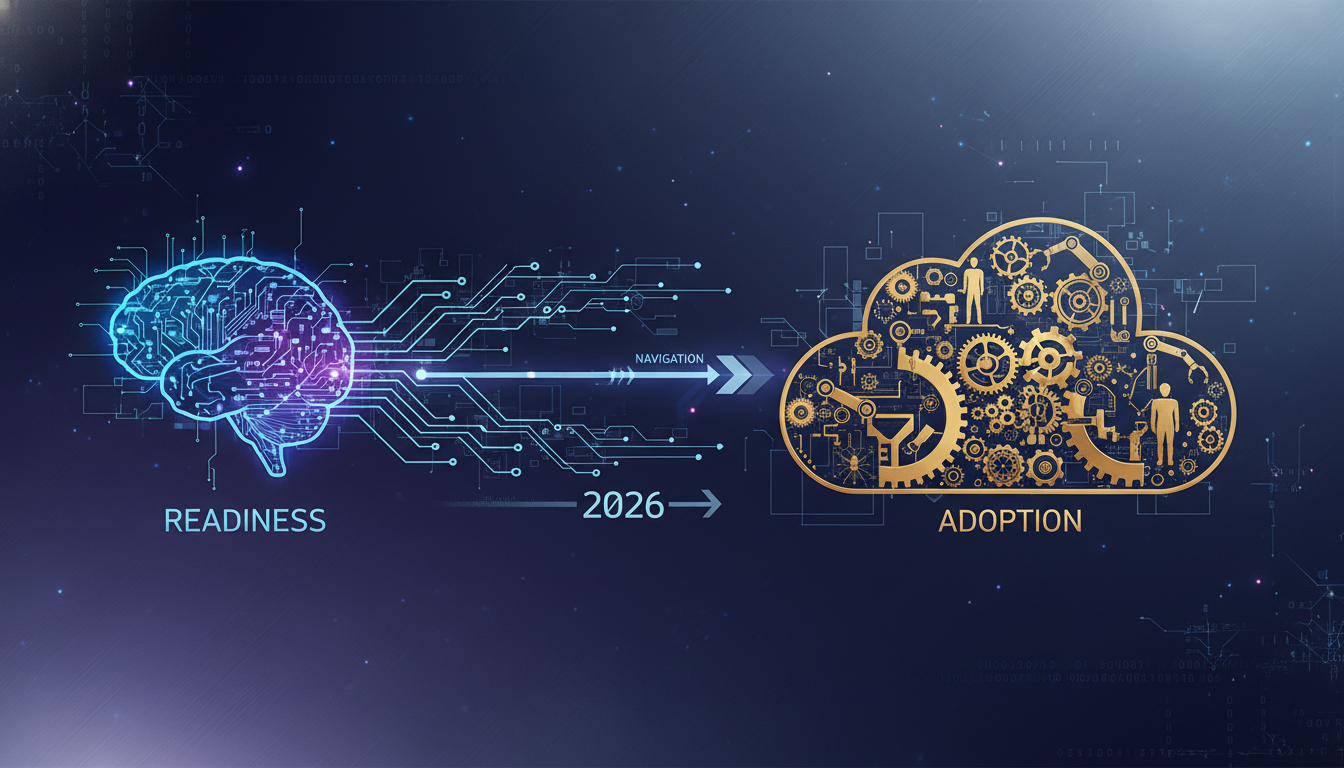
Many enterprise leaders now ask a harder question about AI. It is no longer how fast they can adopt it. It is whether their company is ready to run it in daily work.
This gap explains why so many pilots never reach production. A pilot shows that an idea can work. It does not show that your team, data and rules can support it every day.
Why pilots stall
Boards and competitors push teams to show quick wins. Speed starts to look like success. Teams launch a chatbot, a forecasting tool or an AI assistant within weeks.
Then the problems appear. Each tool sits alone, with its own data and its own owner. Nothing joins up, so nothing scales.
Adoption is a decision. You choose a tool and switch it on. Readiness is a condition of the organisation. It covers your data, your rules, your skills and your ways of working.
Key differences
- Nature: Adoption is a single step. Readiness builds up over time.
- Timeline: Adoption can be fast. Readiness takes steady work.
- Focus: Adoption is about the tool. Readiness is about the team and its data.
- Success measure: Adoption is measured by what was switched on. Readiness is measured by business value.
- Risk: Adoption risks scattered tools. Readiness supports planned growth.
- Ownership: Adoption is often led by IT. Readiness needs the business involved too.
What goes wrong when readiness is missing
We see the same signs again and again. There are too many pilots. The return on investment is unclear. Rules are missing. Several teams buy tools that do the same job. Staff stop trusting the results.
These are not technology problems. They come from how the work is organised. AI also shows weak spots that were already there. Messy data, unclear owners and vague processes all become easier to see once an AI agent depends on them.
The trap of fixing governance later
Many teams say they will sort out governance after launch. Experimentation is good. But skipping the rules creates debt that slows you down later.
Agree a few things before you widen the rollout. Decide which use cases are allowed. Decide who owns each one. Decide when a person must review the AI's answer.
What readiness looks like
- Clear goals: Each AI project links to a business result you can measure.
- Usable data: Your data is good enough and well controlled, so answers can be trusted.
- Clear rules: Policies say how AI may be used and who is accountable.
- Skilled people: Your team knows how to work with AI and maintain it.
- Agreed measures: You set success measures before you build.
How we approach it
We do not treat readiness as a long study that comes before the work. We build it while we ship. Our forward-deployed engineers work inside your team. We follow five steps: discovery, prove, embed, scale and transfer. You can see them on our process page.
In discovery, we pick one workflow with a clear business result. In the prove step, we test it on your real data and with your real users. Then we embed the agent into the daily tools your people already use. That is where most pilots stop, and where we keep going.
As we scale, we add the controls that make it safe to grow: review of low-confidence answers, switches for each team, and dashboards. At the end we hand over. Your people learn to run, change and extend the system without us. If your use case needs it, we can build AI agents that fit this model.
Adoption still matters
Do not delay AI indefinitely. The aim is the right order. Know your business goal, check your data, set your rules and define what scaling means. Then adopt with confidence.
The question for leaders is no longer how fast they can adopt AI. It is how confidently they can run it across the business.
Next step
If your team has AI projects stuck between readiness and adoption in pilot but not in production, book a discovery call.
Saksham Gupta
Founder & CEO, EduBildSaksham Gupta is the founder and CEO of EduBild, which embeds forward-deployed AI engineers with enterprise teams to ship production AI. Ex-Daimler AG; KIT Germany.


