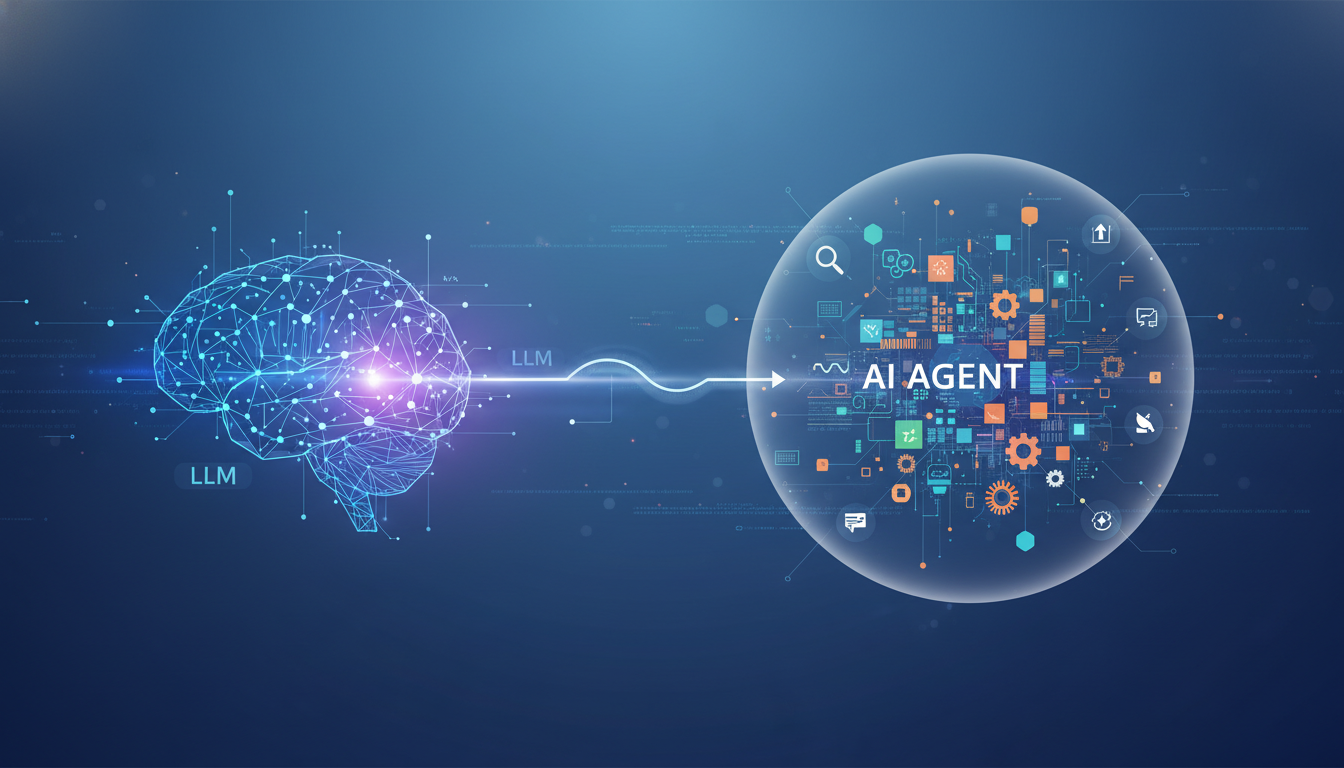
People often mention AI agents and large language models (LLMs) in the same breath. This causes confusion about what each one does. They are not rivals. An LLM is the part that reads and writes language. An AI agent is a full system built around an LLM. It adds planning, tool access, memory and the ability to act.
AI Agent vs LLM: The Basic Difference
An LLM is an AI model trained on large amounts of text. It predicts the next words in a sentence. That makes it good at drafting content, summarizing documents and answering questions.
On its own, an LLM takes a prompt and gives a reply. Current products add some features around it. Many chat tools can now keep notes between sessions. Many can also call tools, such as a search or a calculator. But these are features added around the model, not the model itself. Someone still has to design, connect and control them.
An AI agent is that design work done end to end. It breaks a task into steps. It uses your systems to do each step. It remembers what happened before. It knows when to stop and ask a person.
Why a Model Alone Is Hard to Run in Production
A demo can hide the gaps. In production, three problems show up fast.
Problem 1: Memory
Some tools can now store context between sessions. But a business needs more than that. It needs to decide what is kept, who can see it, and when it is deleted. A customer case that runs over several days needs reliable memory tied to your records.
Problem 2: Taking action
Modern models can be connected to tools, so they can update a record or start a workflow. The hard part is control. Which systems can the AI touch? What can it change? Who checks the result? Someone has to build these limits and test them.
Problem 3: Multi-step work
A task like finding why customers leave has many linked steps. One step depends on the last. A single prompt rarely handles this well. The work needs a plan, checks along the way and a way to recover from errors.
When the Model Alone Is Enough
Many tasks do not need an agent. A model works well when the task is self-contained.
- Content drafting: emails, summaries and first drafts of marketing copy.
- Single questions over your documents: a model can answer from company knowledge when it looks up the right pages first. This is called retrieval-augmented generation (RAG), where the AI looks up your documents before it answers.
- Clear, bounded tasks: translation or sorting feedback as positive or negative.
When You Need an Agent
Look for these signs in the workflow:
- Many systems: the task moves across several tools or databases.
- Linked steps: each step depends on the result of the one before.
- Long memory: the work needs history from earlier days or weeks.
- Exceptions: cases that need judgment, or a person to review them.
- Work without a prompt: the system must watch for events and act on its own.
What Sits Around the Model
An agent has several parts beyond the model. These are clear instructions, a plan for the steps, safe access to tools, and memory. Each part needs testing. Each part also needs rules for what the agent may and may not do.
How We Approach It
We start with the workflow, not the technology. We ask what the work is, who does it today, and where it goes wrong. Often a simple model with good document lookup is enough. We say so when that is the case. We only add the agent layer when the task truly needs it.
Our forward-deployed engineers work inside your team. They build the agent with your people, against your real systems and data. Together we set limits on what the agent can do and when a person must review. You can read more about our AI agent work and how we run a project.
When the agent is in production, we hand it over. Your team learns how it works, how to watch it and how to change it. That is how an agent keeps paying off after we leave.
One example from our work: An autonomous L1 IT support agent that resolves 70% of tickets without a human, around the clock.
Next step
If your team has an AI agent in pilot but not in production, book a discovery call.
Saksham Gupta
Founder & CEO, EduBildSaksham Gupta is the founder and CEO of EduBild, which embeds forward-deployed AI engineers with enterprise teams to ship production AI. Ex-Daimler AG; KIT Germany.


