Introduction
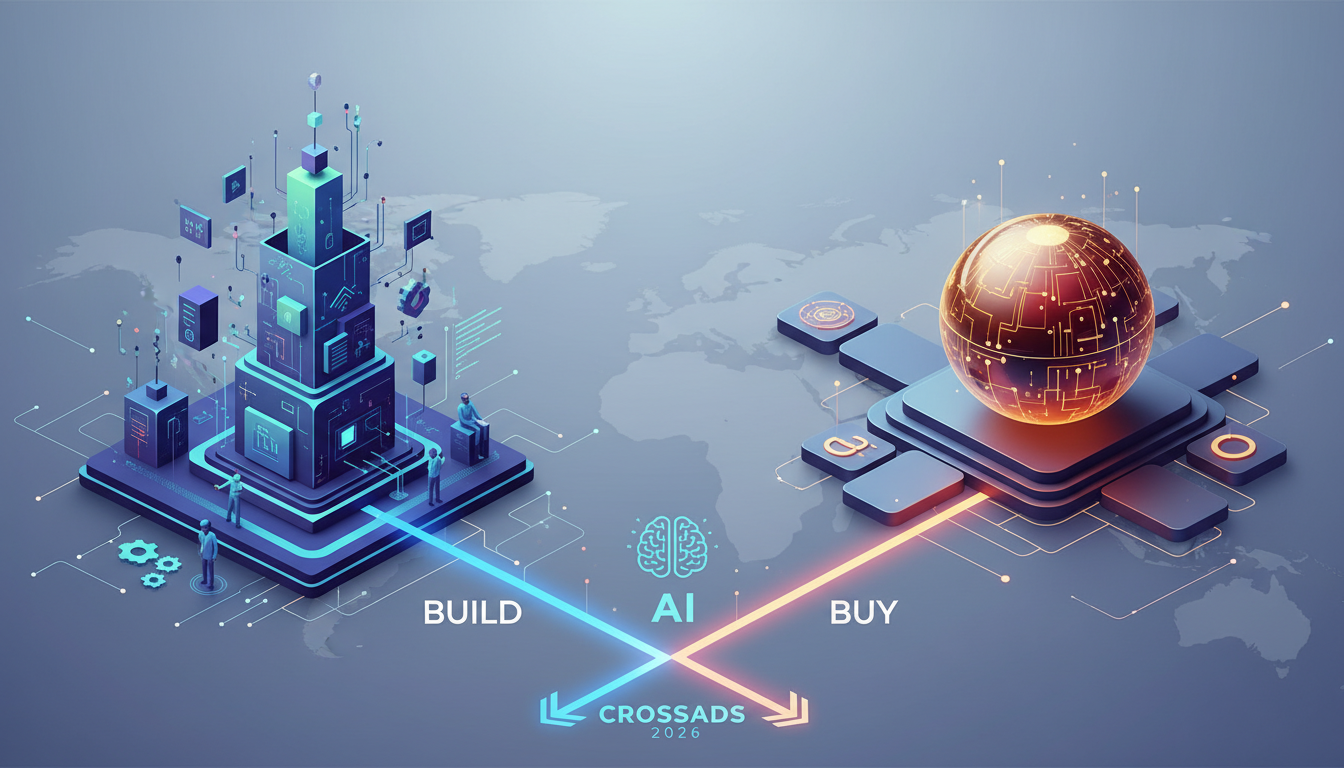
Many enterprises now ask whether to build AI themselves or buy it. The choice affects cost, control and how fast you reach production. It is a real trade-off, and there is a third option we cover below.
This post sets out what each path offers. It also gives a simple way to decide.
Why this decision matters now
AI now sits inside daily work
AI used to be a side experiment. Today it touches customer service, supply chain and finance. A poor choice now slows real work, not just a pilot.
Production is harder than a demo
A working AI system needs more than a model. It needs clean data, secure access, monitoring and people who can fix problems. Many teams underestimate this work, so delays and extra cost follow.
Rules and governance
Data privacy rules and company policies shape what you can deploy. A bought platform may come with some controls built in. A system you build needs its own controls from the start. Check what applies to your data before you choose.
The case for building in-house
Control over design and data
Building gives you full say over how the system works and where your data lives. This matters when data is sensitive.
An edge you own
If your data is unique, a system built around it can set you apart from rivals. You also own the result, which means less reliance on a vendor.
The case for buying
Speed
Ready-made tools and APIs (ways for software to talk to other software) can get a first use case running quickly.
Predictable spending
Buying usually means a regular subscription instead of a large upfront build. That makes planning easier. Watch usage-based charges, which can grow as more people use the tool.
Ready-made security and scale
Vendors often offer security features and room to grow. Check that they fit your own review process.
A third option: embed
Beyond a two-way choice
Many teams mix the two. They buy common parts and build the parts that are specific to their business. That is sensible. But a mix still leaves a gap: who does the work, and who is left able to run it afterwards?
What embedding means
Embedding means specialist AI engineers work inside your team. They build and ship with your people, then hand the system over. You get speed without losing ownership.
How we approach it
At EduBild, we use a forward-deployed model. Our engineers join your team and work on your real workflow, not a demo. We start with a clear process: discovery, proof, embed, scale and transfer.
We help you decide what to buy and what to build, based on your data and your team. Where it fits, we build AI agents that do a defined piece of work inside your tools.
The goal is handover. Your team learns the system as we build it, so it keeps running when we leave.
One example from our work: An embedded engagement with an enterprise software company: five phases across three functions (customer operations, self-service and now professional services), with EduBild engineers working inside the client's own office.
A simple decision checklist
- Time pressure: Urgent needs favour buying or embedding. Long-term skills may justify building.
- Data sensitivity: Highly sensitive data often points to building, or to a mix that keeps that data in your hands.
- Your team's skills: If you lack AI engineers, buying or embedding fills the gap.
- Strategic value: If the capability sets you apart, own it.
- Fit with old systems: A mixed approach often suits complex legacy systems.
Next step
If your team has an AI use case stuck between build and buy in pilot but not in production, book a discovery call.
Saksham Gupta
Founder & CEO, EduBildSaksham Gupta is the founder and CEO of EduBild, which embeds forward-deployed AI engineers with enterprise teams to ship production AI. Ex-Daimler AG; KIT Germany.


