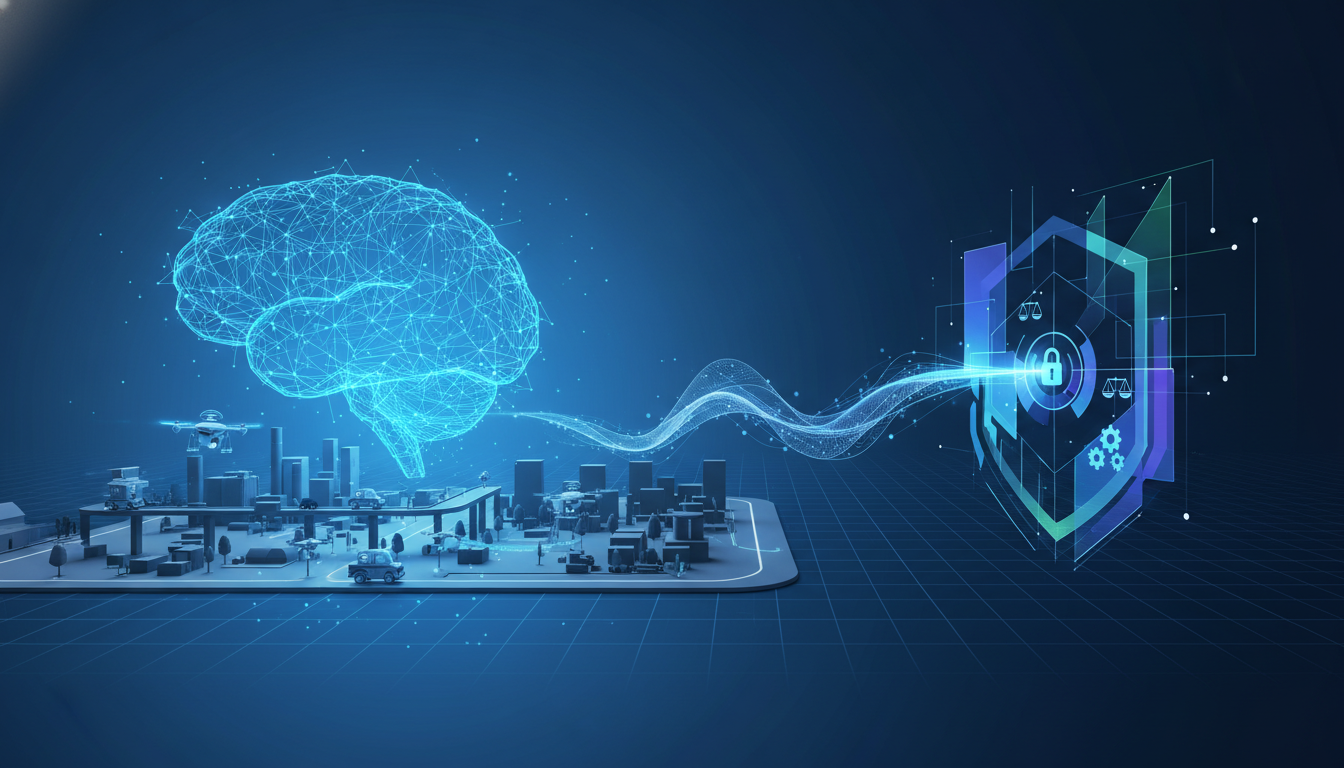
AI used to live on screens. Now it also runs in warehouses, delivery networks and factory floors. When an agent (an AI that plans and takes actions on its own) makes a mistake there, the cost is not a bad email. It can be damaged stock, a stopped line or an injured person.
Most AI rules were written for software. They cover bias, wrong answers and harmful content. Physical operations need more. This post sets out the controls we think leaders should ask for before an agent acts in the real world.
Why physical AI is harder to govern
A software error can often be undone. A physical action often cannot. A robot that moves a pallet to the wrong bay has already moved it.
Three things make this harder in production than in a demo:
- Speed. Agents act faster than a person can check each step.
- Change. Software updates and new conditions change how the system behaves after launch.
- Shared ownership. The model builder, the hardware maker and your operations team each own a part. When something fails, nobody is sure who is responsible.
The controls that matter
Test first, then roll out in steps
Test in simulation and on closed sites before real operations. Then widen use one site or one team at a time. Not every risk shows up before launch, so a first approval is not enough. Watch real performance after go-live.
Keep an audit trail
An audit trail is a record of what the agent saw, what it decided and what it did. Without it, you cannot explain an incident or fix its cause. It also settles the question of who was responsible at each step.
Send low-confidence cases to a person
Every agent has moments when it is unsure. Set a confidence level below which the agent stops and asks a human. Choose that level with the people who run the workflow, and review it as you learn.
Give each team an off switch
Each team or site should be able to pause the agent on its own, without waiting for the engineers. A clear off switch makes teams more willing to try agents at all.
Monitor and learn
A dashboard should show what the agent did, how often people overrode it and what each action cost. Feed those overrides back into the system so it improves.
How we approach it
We are forward-deployed engineers. We work inside your team, not beside it. We sit with the people who run the warehouse, the plant or the service desk, and we learn where a wrong action does real harm.
We build the controls above into the first release, not as a later add-on. That means audit trails, review thresholds, per-team switches and dashboards, set up with your security and operations leads. Where data must stay in your own environment, we can use an on-premise setup.
We then follow our process: discover, prove, embed, scale and hand over. At handover your people own the controls and know how to run them. Our AI agents work follows the same pattern.
Questions to ask before an agent acts in the physical world
- Can we see a full record of every action the agent took?
- At what confidence level does it hand over to a person, and who chose that level?
- Can one team pause it without help from engineering?
- Do we roll out in stages, with real-world checks at each stage?
- Who is accountable at each link: model, hardware and operations?
If you cannot answer these, the pilot is not ready for production. Public frameworks on agent governance are emerging in several countries. Check the current official text for your market before you rely on any of them.
Next step
If your team has physical-world AI agents in pilot but not in production, book a discovery call.
Saksham Gupta
Founder & CEO, EduBildSaksham Gupta is the founder and CEO of EduBild, which embeds forward-deployed AI engineers with enterprise teams to ship production AI. Ex-Daimler AG; KIT Germany.


