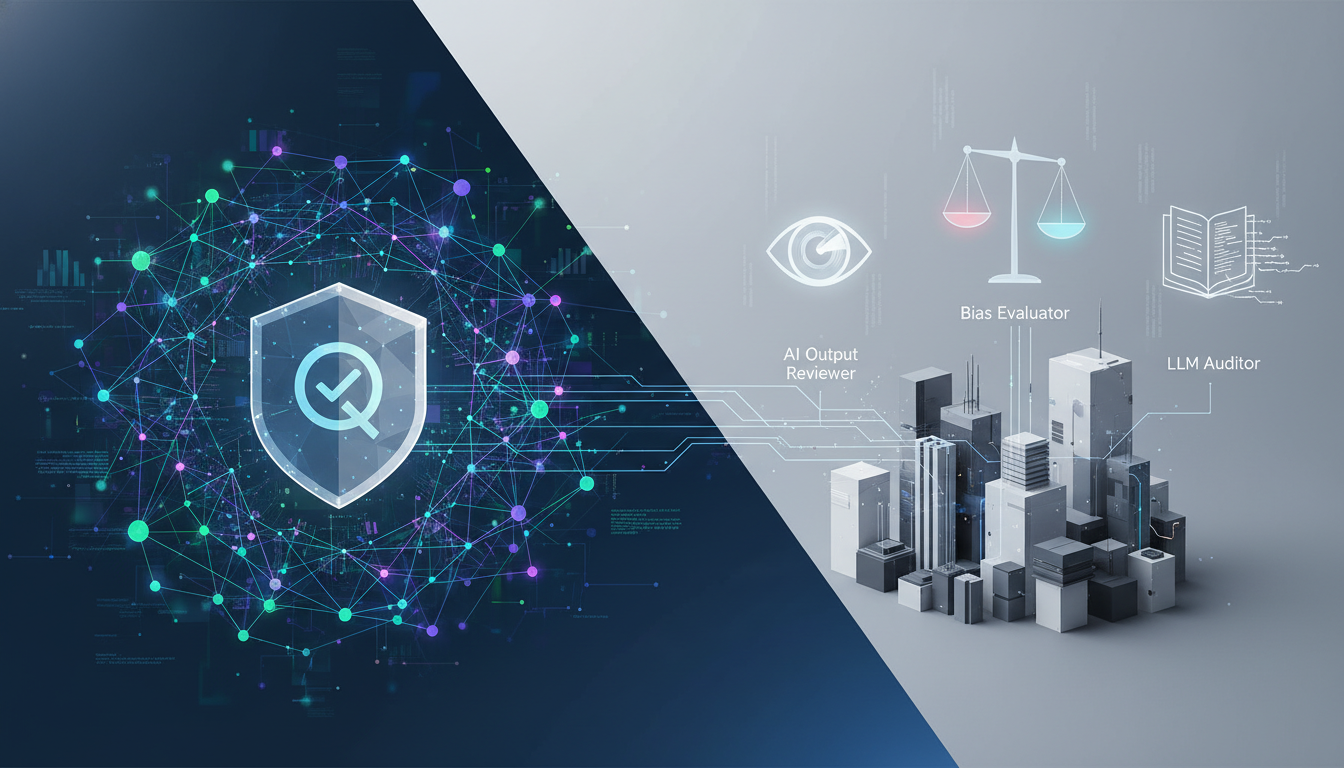
AI is now part of daily work in many companies. Traditional software testing does not fit it well. New quality roles are needed to check what AI says and does. In 2026, three roles matter most: the AI Output Reviewer, the Bias Evaluator and the LLM Auditor. An LLM is a large language model, the kind of AI behind most chat and writing tools.
The shift: from testing software to checking AI decisions
For years, quality teams tested software against a fixed specification. The result was pass or fail. The same input gave the same output every time.
AI does not work this way. The same question can get different answers. An answer can be fluent and still wrong. So the job changes from "does it match the spec?" to "is this answer good enough to act on?"
AI Output Reviewer: the first line of quality control
The AI Output Reviewer checks what the AI produces before it reaches a customer or an employee. This person needs a good eye for writing, a feel for how people read answers, and a testing mindset.
What an AI Output Reviewer does
- Sets simple scoring rules for accuracy, safety and tone.
- Samples real outputs from production and grades them.
- Spots "hallucinations", which are confident answers that are made up.
- Feeds findings back to the team so the agent improves.
This role also owns human review. When the AI is not confident in an answer, a person looks at it first. The team sets the confidence level that triggers this review.
Bias Evaluator: checking for unfair results
The Bias Evaluator looks for unfair patterns in AI answers. These can show up as different treatment by gender or region, cultural mistakes, or weaker answers in some languages. This matters a lot in hiring, assessment and customer service.
What a Bias Evaluator does
- Builds test sets that expose unfair patterns.
- Reviews large batches of outputs to find them.
- Works with engineers to fix what the tests find.
LLM Auditor: keeping a record you can trust
The LLM Auditor works a bit like a financial auditor. This person makes sure every AI action can be traced and explained later. If someone asks "why did the agent do that?", there is an answer on file.
What an LLM Auditor does
- Keeps audit trails: a log of inputs, outputs and decisions.
- Tests the system by trying to break it.
- Makes sure quality checks run each time the AI is updated.
- Prepares clear reports for leaders and risk teams.
How the three roles work together
These roles should not sit apart. The reviewer finds day-to-day problems. The bias evaluator finds patterns across many answers. The auditor keeps the record and checks that the controls work. Together they form one quality loop for your AI.
Skills your quality team needs next
- Writing clear instructions for AI, and seeing how changes affect answers.
- Checking data quality and testing the riskiest cases first.
- Measuring AI answers against agreed scores, and spotting bias.
How we approach it
Most pilots stall because nobody owns quality once the demo ends. At EduBild, we place forward-deployed AI engineers inside your team. They build the agent and the review controls together, in your workflow, from the first week.
We set up human review below a confidence level, audit trails, feedback loops and per-team on/off switches. We build them with your reviewers, so the people who will run them help design them. You can see how this works in our process.
Then we hand over. Your team gets the dashboards, the scoring rules and the skills to run them. Our AI agents work is built so that your people stay in control after we leave.
What to do in 2026
- Name one owner for AI output quality before an agent goes live.
- Decide which answers need a person to check them first.
- Keep a log of what the AI did, and review it on a schedule.
- Test for unfair results in every language and group your users represent.
Next step
If your team has AI output review in pilot but not in production, book a discovery call.
Saksham Gupta
Founder & CEO, EduBildSaksham Gupta is the founder and CEO of EduBild, which embeds forward-deployed AI engineers with enterprise teams to ship production AI. Ex-Daimler AG; KIT Germany.


