Why complex documents are hard to read by machine
Many enterprise documents are not simple pages of text. They have dense tables, maths formulas and columns that run side by side. When OCR (software that turns scanned pages into text) misreads one of these, the error can reach a financial report, a research file or a legal record.
So how can your team get accurate results without paying more for every page?
Does more AI reasoning mean better OCR?
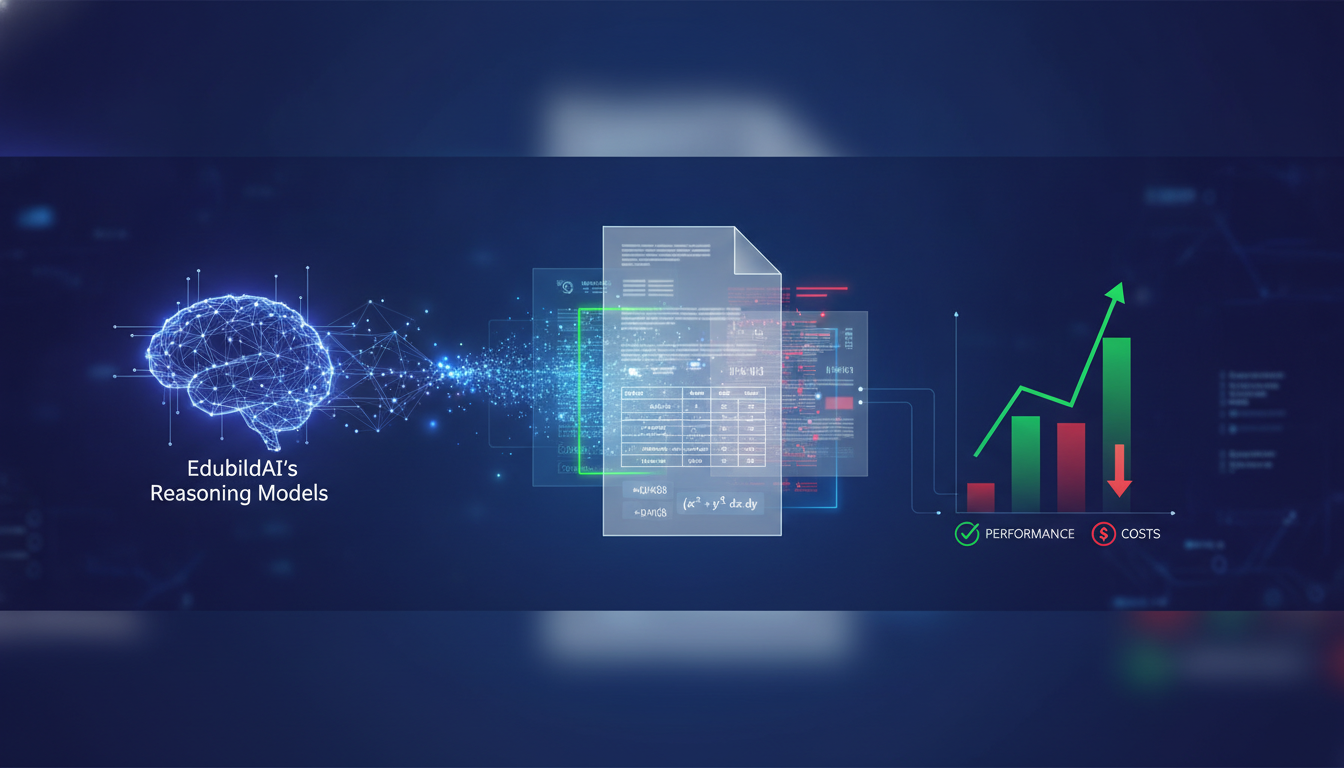
Some newer AI models spend extra effort "thinking" before they answer. This is called reasoning. For OCR, it can help on hard parts of a page, such as a complex table or text that runs in mixed directions.
But more reasoning does not always give better reading. In our own testing, higher reasoning settings on one large model did not improve quality. They did make each page slower and more costly. That is a poor trade for a team that must process thousands of documents.
Pipelines work better than one big pass
A single-pass system asks one model to see, read and organise a page all at once. A pipeline splits the job into steps. One tool reads the characters on the page. A language model (LLM) then puts the text in order, for example as a clean table.
Models that overthink can make mistakes of their own. They may split one table into two, or guess at content that is not on the page. A pipeline keeps reasoning for the places where it adds value. A check step can also compare the organised output with the raw page and catch errors early.
Can this lower OCR cost?
Yes. Cost drivers for document AI are mostly the length of each model run and how many pages need extra effort. If you use heavy reasoning on every page, cost and waiting time both go up. If you use it only on hard pages, both come down.
One example from our work: RAG search for a national statistics ministry: questions in Hindi, English and Kannada, by voice or text, with citations that link to the exact source page. 490+ legacy statistical tables indexed and queryable in plain language.
You can read more about our document AI and OCR work.
How we approach it
We do not start with a model. We start with your documents and your workflow. Our forward-deployed engineers work inside your team. We look at which pages cause errors today and what a wrong answer costs you.
Then we build a small pipeline on your real files, test it against your own measures of quality and cost, and ship it into daily use. We add checks so that low-confidence pages go to a person. Our process ends with handover, so your people can run and change the system themselves.
What this means for AI in production
A demo on ten clean pages tells you little. In production, your system sees poor scans, odd layouts and heavy volume every day. Cost per page, speed and error rates all matter at once.
Track these from the first week. Set a limit on reasoning effort. Log which pages needed a human. Review the results with the business owner each month. Teams that do this can tune the system with evidence instead of guesses.
Common questions
Does reasoning help with logos and icons? It can. A reasoning model can use context to explain what an image shows, instead of just copying it as text.
Can the system handle low-quality scans? Reading the page at its original resolution keeps small details that shrinking the image would lose. Very poor scans should still go to a person for review.
Where does the cost saving come from? From using reasoning only where a page needs it, and from shorter processing time on easy pages.
Next step
If your team has slow or costly document reading in pilot but not in production, book a discovery call.
Saksham Gupta
Founder & CEO, EduBildSaksham Gupta is the founder and CEO of EduBild, which embeds forward-deployed AI engineers with enterprise teams to ship production AI. Ex-Daimler AG; KIT Germany.