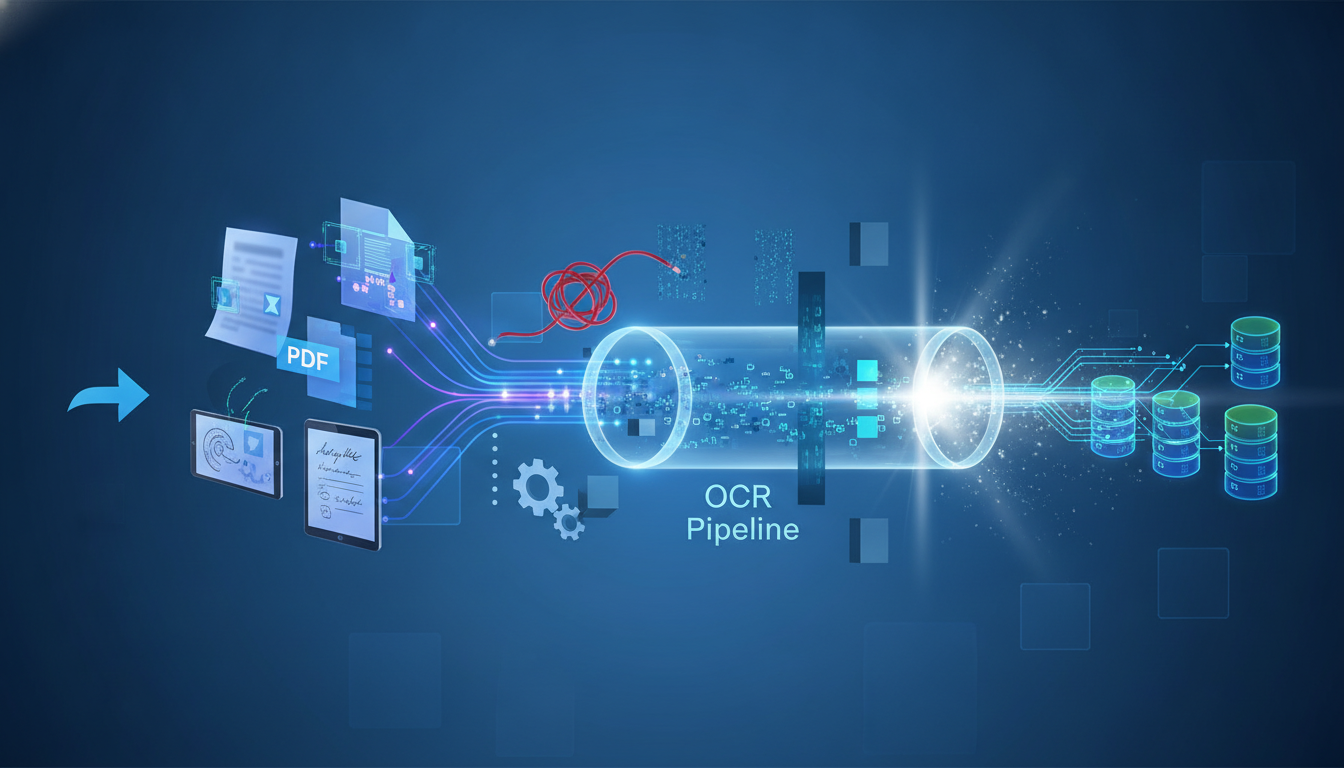
Your teams receive scanned invoices, PDFs and handwritten notes every day. You need that data in your systems as clean, structured fields. Many pilots read a few clean samples well, then fail on real documents.
OCR (optical character recognition) is software that turns images of text into text a computer can read. A good pipeline does more than that. It takes in the file, cleans the image, finds the text, reads it and works out the layout. Each step must hold up on messy, real documents.
What makes building an OCR pipeline hard?
Running an OCR tool on a page is easy. Making it work across every document your business receives is hard. Files arrive as scans, digital PDFs and phone photos. Image quality varies. Layouts differ. Some pages have handwritten notes.
Basic OCR reads characters but does not understand structure. It cannot tell a table from a paragraph. So the pipeline also needs layout analysis and checks on the output. Without them, the data is hard to trust and hard to load into your systems.
How does document ingestion set the foundation?
Ingestion is the first step. It brings in documents from email attachments, document systems and scanned uploads. It then converts them into one standard format.
This matters because every later step depends on it. A scanned invoice and a digital PDF should reach the next stage in a form the pipeline handles the same way. Careful ingestion prevents many errors later.
Why is image preprocessing important?
Preprocessing cleans the image before any text is read. Real documents are often skewed, faint or noisy, especially when staff photograph them on a phone.
Typical fixes are straightening the page, removing noise and adjusting contrast. These small steps help the next stages read text correctly.
How do text detection and recognition work?
Text detection finds the areas of a page that hold text. It draws boxes around words, lines or blocks. If it misses an area, the text in it is lost.
Recognition then reads the characters inside each box. Modern AI models do this well. But the result is still a flat stream of text with no structure.
What role does layout analysis play?
Layout analysis rebuilds the structure of the page. Invoices and forms have tables, headers and several columns. The pipeline looks at where each piece of text sits to understand how it relates to the rest.
This is how a line item stays linked to its price and quantity. Without it, you get text but not usable data.
Implementation considerations
Three questions matter most before you build.
- Document types: does the technology cover the formats you actually receive?
- Volume: can it handle your busiest days?
- Integration: can it feed your databases, ERP and reporting tools?
Our document AI and OCR work starts from these questions.
How we approach it
We do not treat OCR as a stand-alone tool. We embed forward-deployed AI engineers inside your team. We start with discovery, looking at the documents your people really handle. Then we prove the approach on a real workflow, build it with your team, and hand it over. You can see the steps on our process page.
Trust controls are part of the build from day one. The system gives each extracted field a confidence level. When confidence is low, the document goes to a person for review. Every step is logged, so you can see what was read, what was changed and by whom. You can also switch the system off for one team without stopping the others.
Where documents are sensitive, we can run the models inside your own environment. Our engineers train your staff along the way, so your team can run and improve the pipeline after handover. For a wider view of agents built on top, see our AI agents work.
FAQ
What are the common challenges in designing an OCR pipeline? Mixed file formats, uneven image quality and complex layouts. It is also hard to read text accurately while keeping the structure of the page.
How can enterprises check the accuracy of OCR output? Clean images first and test the models on your own documents. Then check extracted data against expected formats and business rules. Send low-confidence results to a person.
Why is layout analysis important? It rebuilds tables and headers correctly. That turns raw text into structured data your systems can use.
Next step
If your team has document data extraction in pilot but not in production, book a discovery call.
Saksham Gupta
Founder & CEO, EduBildSaksham Gupta is the founder and CEO of EduBild, which embeds forward-deployed AI engineers with enterprise teams to ship production AI. Ex-Daimler AG; KIT Germany.


