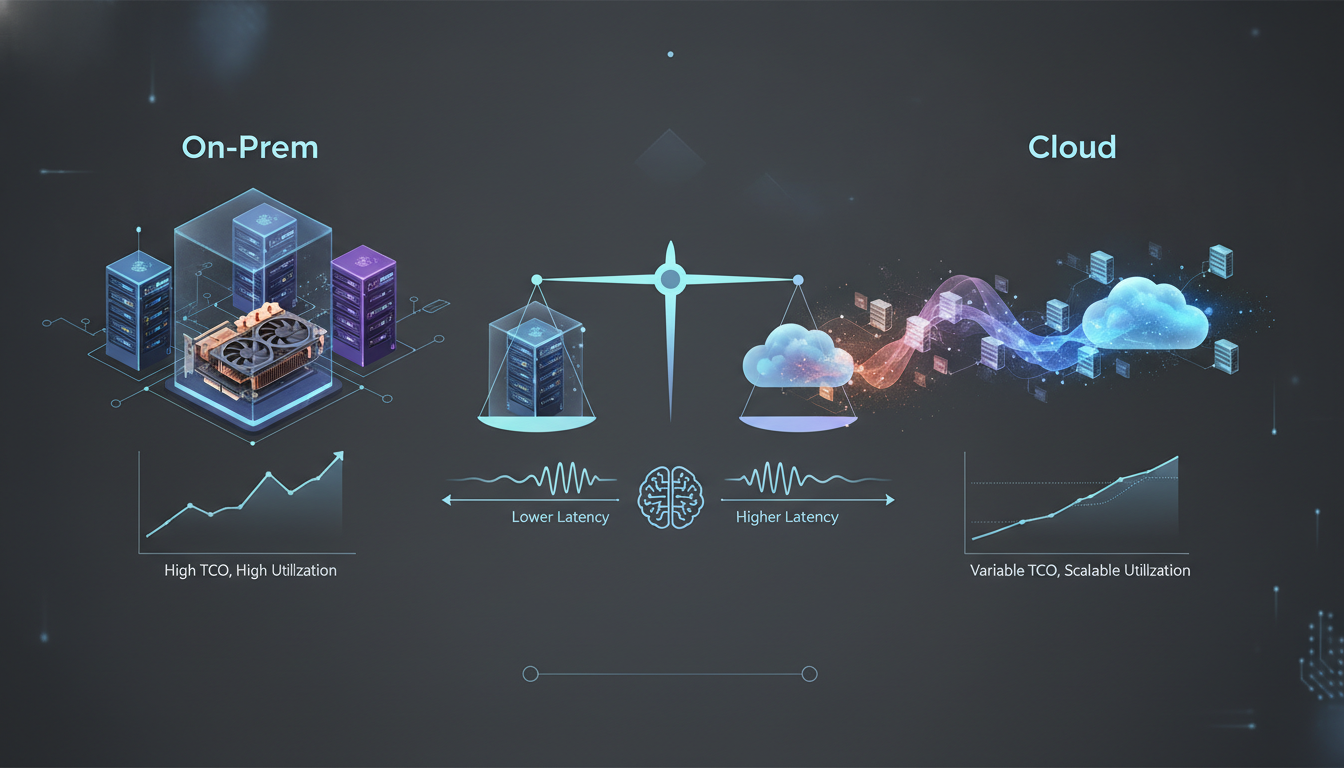
Your team has a working AI prototype that runs on a hosted API. Now finance, security and engineering all ask the same thing. Do we keep paying per token, or buy GPUs and run the model ourselves? (A token is a small piece of text the model reads or writes. A GPU is the specialised chip that runs the model.)
The answer is not just a price comparison. Three things matter more than the list price: how steadily your team uses the model, how sensitive your data is, and how predictable response times must be. Cloud APIs usually win for small, uneven or exploratory workloads. Your own servers ("on-prem") or a private setup tend to win when demand is steady and high, when data cannot leave your boundary, or when chains of AI agents need predictable speed. A mix of both is the most common result.
Why is running a model a different job from training one?
Training is a large batch job. You book capacity, run it, and wait for the result. Jobs can sit in a queue.
Running a model for users ("inference") is a live service. It must answer requests quickly. It must stay up around the clock. It must cope with traffic you cannot predict. The measures change too. You track how long a user waits for the first word, how many words per second they get, and how slow the slowest requests are. A model that is fast in a benchmark can still be a poor service if requests pile up under load.
Many enterprises budget for inference as if it were a software purchase. In practice it is an engineering commitment. Someone must run the serving software, handle traffic spikes, apply patches, watch the system and answer the phone at night. Cloud providers do most of that for you. On your own servers, your team must build those skills or buy them.
In our work on on-prem LLM deployment, the first question is rarely which model to run. It is who runs the service after go-live, and what level of service the business expects. That answer decides whether private hosting is realistic for your team.
Where does GPU cost get wasted?
The most common mistake is sizing a cluster for peak load and then paying for it all day. Enterprise traffic is rarely flat. An internal assistant may be busy in office hours and almost unused overnight. When a GPU sits idle most of the day, the real cost of each token is much higher than the headline figure.
Other pitfalls come up again and again:
- Poor batching. Serving one request at a time wastes the chip. Grouping requests together raises throughput, but each user may wait a little longer.
- Memory limits. Long documents use up the GPU's memory before its processing power is full. You run out of room while the chip looks idle.
- Too many models. Five lightly used models on five dedicated GPUs cost far more than one shared pool with sensible routing.
- Mixed hardware. Different GPU generations make planning harder.
- Spare capacity. Backup machines for failures are needed. Count them as a cost instead of hiding them.
Before you buy hardware, measure real use on a cloud API for several weeks. Record how much text goes in and out, how many people use it at once, and how long the documents are. That data is the best guide for sizing.
How do you compare total cost?
Cloud cost is variable and easy to model: text volume multiplied by a rate. Private cost is mostly fixed, and the work is in finding every line item. Compare over at least three years.
| Cost area | Cloud API | Private / on-prem |
|---|---|---|
| Hardware | None | GPUs, servers, networking, storage |
| Facilities | None | Power, cooling, rack space |
| Usage cost | Grows with volume | Mostly fixed once capacity is bought |
| Engineering | Integration only | Running, patching, monitoring, on-call |
| Idle capacity | Not billed | Paid whether used or not |
| Hardware refresh | The provider's job | Your job, every few years |
| Compliance work | Vendor review, data transfer review | Inside your own audit scope |
The break-even idea is simple. If your use is steady and high, the fixed cost per token falls below the API rate, and private hosting wins. If use is low or uncertain, cloud wins. Where the line falls depends on model size, hardware cost, and delivery times. In India, import steps can add delay and cost to GPU purchases. Get current quotes from vendors, because prices and availability change quickly.
Open-weight models (models whose files you can download and run yourself) also change the sums. A smaller model, shrunk to use less memory and tuned for one narrow task, can need far less hardware than a very large one.
When does data control matter more than cost?
Sometimes the cost model does not matter, because the data cannot leave. Government bodies, banks, insurers and healthcare providers often work under contract or legal limits on where data is processed and who can see it. Your internal data-classification rules add to that. Ask your legal and security teams what applies to you.
Three practical questions help:
- Do the questions or the retrieved documents contain personal, confidential or classified information?
- Are the provider's data handling, storage time and list of sub-contractors acceptable to your legal and security teams?
- Can you show an auditor where the model ran and who could see the data?
If the answer to the third question must be "inside our boundary", private deployment is the path.
One example from our work: RAG search for a national statistics ministry: questions in Hindi, English and Kannada, by voice or text, with citations that link to the exact source page. 490+ legacy statistical tables indexed and queryable in plain language.
Control is also about dependence. A single outside provider can change its price, retire a model version or change its terms. A model you run yourself stays the same until you change it. That matters when your prompts and tests are tuned to one model's behaviour.
Why does speed matter more for chains of agents?
A single chatbot can survive an occasional slow reply. A chain of AI agents cannot. Say a coordinating agent calls a planner, then three agents that use tools, then a checker. Each step waits for the one before. Delays add up, and so does the variation between fast and slow runs.
Picture five steps, each usually quick but sometimes very slow. The chance that at least one step is slow is much higher than for any single call. So the slowest step sets the experience for the whole chain. Users feel the slow runs, not the average ones.
Shared cloud endpoints add variation you cannot control. Other customers' traffic, usage limits, regional congestion and silent model updates all play a part. Reserved cloud capacity reduces this. So does private hardware, where you own the queue. With your own servers, you can keep capacity for time-sensitive agents and move batch jobs to quiet hours.
When we design AI agents for enterprise use, we set a time budget for each step, plus a timeout and fallback plan, before we choose infrastructure. Often the best fix is in the design: fewer steps in a row, small models for sorting and routing, and parallel calls where steps do not depend on each other.
How should you match model size to each task?
Not every agent needs the biggest model. Routing, sorting requests, pulling out fields and formatting are often handled well by a small model. Planning and hard reasoning may need a larger one. Matching size to task cuts cost and delay, and it changes how many GPUs you need.
| Tier | Typical tasks | Model type | Where it runs |
|---|---|---|---|
| Fast | Routing, sorting, spotting personal data | Small, shrunk to save memory | Local GPU |
| Standard | Answers based on your documents, summaries | Mid-size open-weight | Private cluster |
| Heavy | Complex planning, rare hard cases | Large model | Cloud or reserved capacity |
This is why mixed setups are common. Sensitive, high-volume, time-critical traffic stays on infrastructure you control. Rare heavy tasks go to a cloud endpoint. A gateway (a traffic controller that sits in front of the models) decides based on data type and load. Make sure it enforces your rules, so a restricted document can never be sent outside by mistake.
Smaller models also gain the most from LLM fine-tuning, which means training them further on your own domain data. It can close much of the quality gap on narrow tasks. Check that with your own test set instead of assuming it.
Should knowledge live in the model, in retrieval, or both?
Retrieval-augmented generation (RAG) means the AI looks up your documents before it answers. It keeps knowledge current and checkable, because answers can cite their sources and you can update the document index without retraining. For most enterprise knowledge tasks it is the right start.
It also affects cost. Retrieved text makes each request longer, and longer requests need more GPU memory and processing.
Fine-tuning solves a different problem. It helps when the model misreads internal terms, product codes or how your concepts relate. It can also shorten requests, because the model needs fewer instructions and examples.
The two work together. Build retrieval first and study where it fails. Fine-tune only where errors come from domain language and not from missing documents. A system that retrieves a lot of text is hungry for memory. So GPU memory, not raw speed, may decide how many people one GPU can serve at once.
How should you start?
Start with measurement, not purchasing. Run the workload on a cloud API for four to eight weeks. Record how much text flows, how long documents are, how many people use it at once, and how slow the slowest requests are at each agent step. This data replaces guesswork in your cost model.
Next, classify your data. Decide which workloads must stay inside your boundary and which can use outside endpoints. This one step often splits the project into a private core and a cloud edge.
Then choose who will run it. Be honest about whether you have people to run GPU systems, patch the software, track security flaws and handle incidents at 2 a.m. If not, a managed private setup or a partner-run cluster may beat a do-it-yourself build.
Finally, plan for change. Models improve every few months, while hardware lasts for years. Build a layer between your apps and the models so you can swap models and move work between private and cloud without rewriting. Add monitoring from day one: text volume per request, queue length, GPU memory and use, and cost by team. Without it, you cannot tell whether your cluster is efficient or just busy.
How we approach it
We do not start with hardware or a vendor. Our forward-deployed engineers work inside your team and begin with your real workload. We measure what your pilot actually uses, then help you decide what stays private and what can go to the cloud.
We build the first agents with your people, not for them. That means your engineers see how the serving layer, routing and monitoring work from the start. Our process moves from discovery to proof, then to a production rollout, and ends with a handover.
By handover, your team owns the system. It should know who operates it, how to read the dashboards and how to change a model without breaking the apps around it. We want you to be able to run it without us.
FAQ
At what volume does on-prem become cheaper than cloud? There is no universal threshold. It depends on model size, how steadily the GPUs are used and the API rate you compare against. Model it with your own measured volumes over three years. Steady high use favours private hosting. Uneven use favours cloud.
Can we run a mixed setup? Yes, and it is the most common design. A gateway routes by data sensitivity, speed need and load. Sensitive traffic stays private, and rare heavy tasks use cloud capacity.
Do smaller models work for agent workflows? Often, for routing, extraction and sorting. Check on your own test set, because quality varies by task and domain. Fine-tuning can help close gaps.
What is the biggest hidden cost of running your own? Idle capacity and engineering time. Underused GPUs and the staff needed to run the system often cost more than the hardware itself.
Next step
If your team has a private-versus-cloud AI decision in pilot but not in production, book a discovery call.
Saksham Gupta
Founder & CEO, EduBildSaksham Gupta is the founder and CEO of EduBild, which embeds forward-deployed AI engineers with enterprise teams to ship production AI. Ex-Daimler AG; KIT Germany.