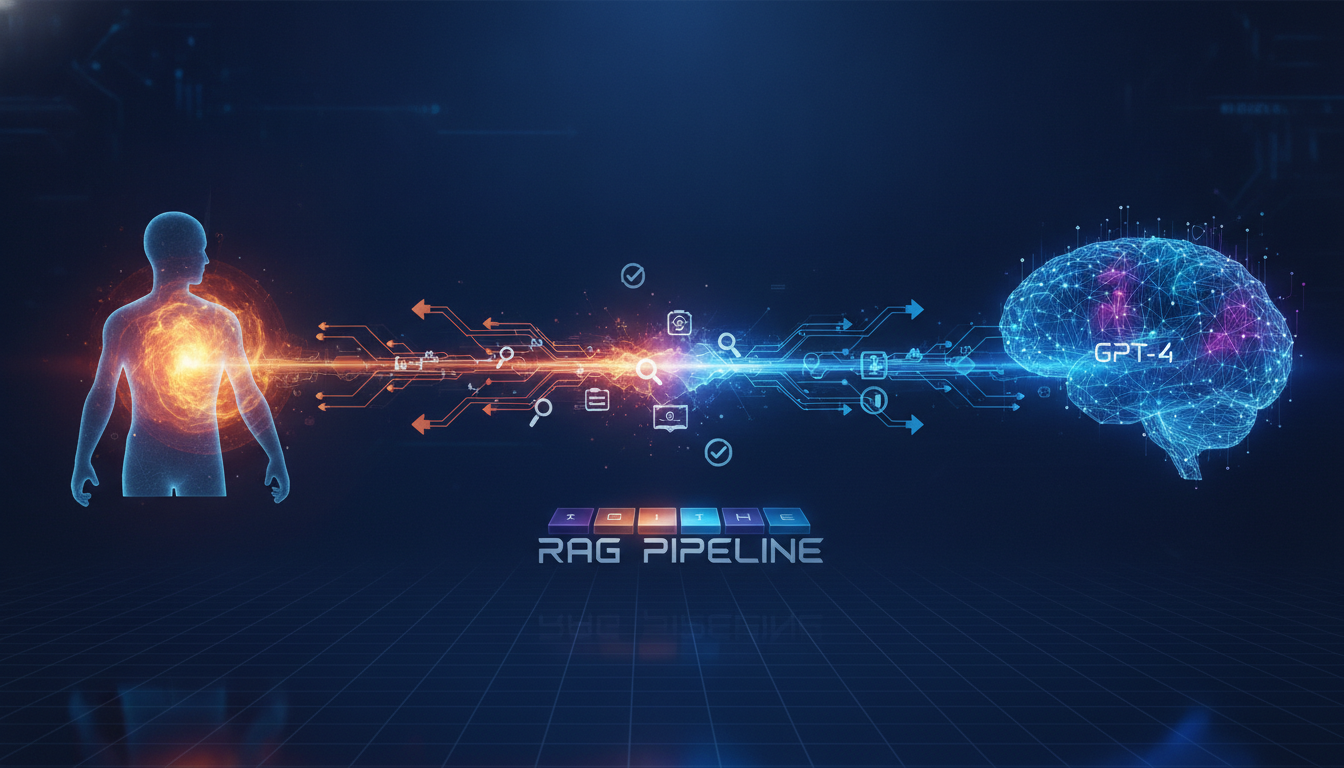
Many teams build a RAG system and then get stuck on one question. How do you know its answers are good? RAG, short for retrieval-augmented generation, means the AI looks up your documents before it answers.
The usual fix is to use a second AI model as a judge. It reads each answer and scores it. Two options come up often: GPT-4, a closed model from OpenAI, and Prometheus, an open-source model built for judging. Here is how we think about the choice.
How do the two judges compare on correctness?
Correctness asks one thing: does the answer match a trusted reference answer? Both models can score this against a written rubric, which is a simple list of what a good answer must contain.
GPT-4 is a strong general reader. It often copes well with long or tricky questions without much setup. Prometheus may need more tuning out of the box. In return, you can write your own rubric and teach the model what "good" means in your business.
That matters in niche work. A rubric for an auto-parts quality manual is not the same as one for a service desk. An open model can be fine-tuned, which means trained further on your own examples, so it learns your standard.
What about faithfulness?
Faithfulness asks whether the answer stays true to the documents the system found. When it does not, the AI is making things up. This is the check that catches invented answers.
GPT-4 is generally good at holding context across many kinds of text. Prometheus lets you adjust how strict the check is. A finance team may want a very strict judge that flags any claim not found in the source. A support team may accept a looser one.
Whichever you pick, test the judge itself. Have a human expert score a sample of answers, then compare the expert scores with the judge scores. If they differ a lot, the judge is not ready.
Which judge handles context relevancy better?
Context relevancy asks whether the documents the system found fit the question. If the wrong pages come back, even a perfect writer will give a poor answer.
GPT-4 usually reads subtle wording well. That helps in areas like customer support, where people phrase the same problem in many ways. Prometheus lets you define what "relevant" means for your own content. That can help when your documents use special terms that a general model does not know.
The honest answer is that it depends on your data. Run both on a small set of your own questions before you decide.
What do the cost differences look like?
A closed model is usually paid for by use. Each answer you judge adds to the bill. If you score thousands of answers every day, the bill grows with volume. It also grows when you re-run tests after every change to the system.
An open model has a different cost shape. You pay for the computers that run it and the people who look after it. There is no charge for each call. For heavy testing, that can be easier to plan. For light use, the closed model may be cheaper, because you skip the setup.
Do the sums with your own volumes, not a general rule. Count test runs, the size of each document, and how often you will re-test.
How easily do they fit into an existing system?
GPT-4 is reached through an API, a standard way for software to talk to a service. It has full documentation and a large user community. Setup is quick.
Prometheus is a model you host yourself. That takes more work at the start. Once it runs, you control it. It can also sit behind the same testing tools your team already uses, so switching judges later is less painful.
What are the security considerations?
When you use a closed model, your text travels to an outside service. You need to be comfortable with the provider's terms and with what you send. Some teams are fine with this. Others are not.
An open model can run inside your own walls. Your documents and scores never leave. This matters most for public-sector, health and other teams with sensitive records. Our on-premise LLM deployment work covers this setup. Before you choose, ask your security team to review the data flow, and check which rules apply to you.
How we approach it
We do not start by picking a model. We start by asking what a good answer means to your team. Then we write that down as a rubric, with your experts, and use it to test every change.
Our engineers are forward-deployed. That means they work inside your team, not at a distance. They build the test set from your real questions, compare the judges side by side, and show you where each one agrees or disagrees with your experts. You decide with evidence.
Then we hand over. Your people get the test set, the rubric, the dashboards and the know-how to keep them current. You can see how we work on our process page. If the system you are judging is a RAG system, we build and test it together.
What this means for your organisation
This is a business choice, not only a technical one. Three things should drive it.
- Control. Do you need to tune the judge and keep data inside your walls? Lean towards an open model.
- Speed to start. Do you need a working judge this month with little setup? A closed model is often faster.
- Trust. Whichever you pick, check it against human experts first. A judge nobody has checked is a risk.
Many teams use both. They use a closed model to start fast, then move to an open one as volume grows.
FAQ
Is Prometheus right for every RAG test?
No. It can fit many tests, but it may need tuning for your content. Check it against expert scores first.
How do updates work?
A closed model is updated by its provider, so its scores can shift without warning. An open model changes only when you change it, which makes your results easier to compare over time.
Can we use both?
Yes. You can run both on the same questions and compare. Where they disagree, a human reviews the answer.
Next step
If your team has RAG evaluation in pilot but not in production, book a discovery call.
Saksham Gupta
Founder & CEO, EduBildSaksham Gupta is the founder and CEO of EduBild, which embeds forward-deployed AI engineers with enterprise teams to ship production AI. Ex-Daimler AG; KIT Germany.