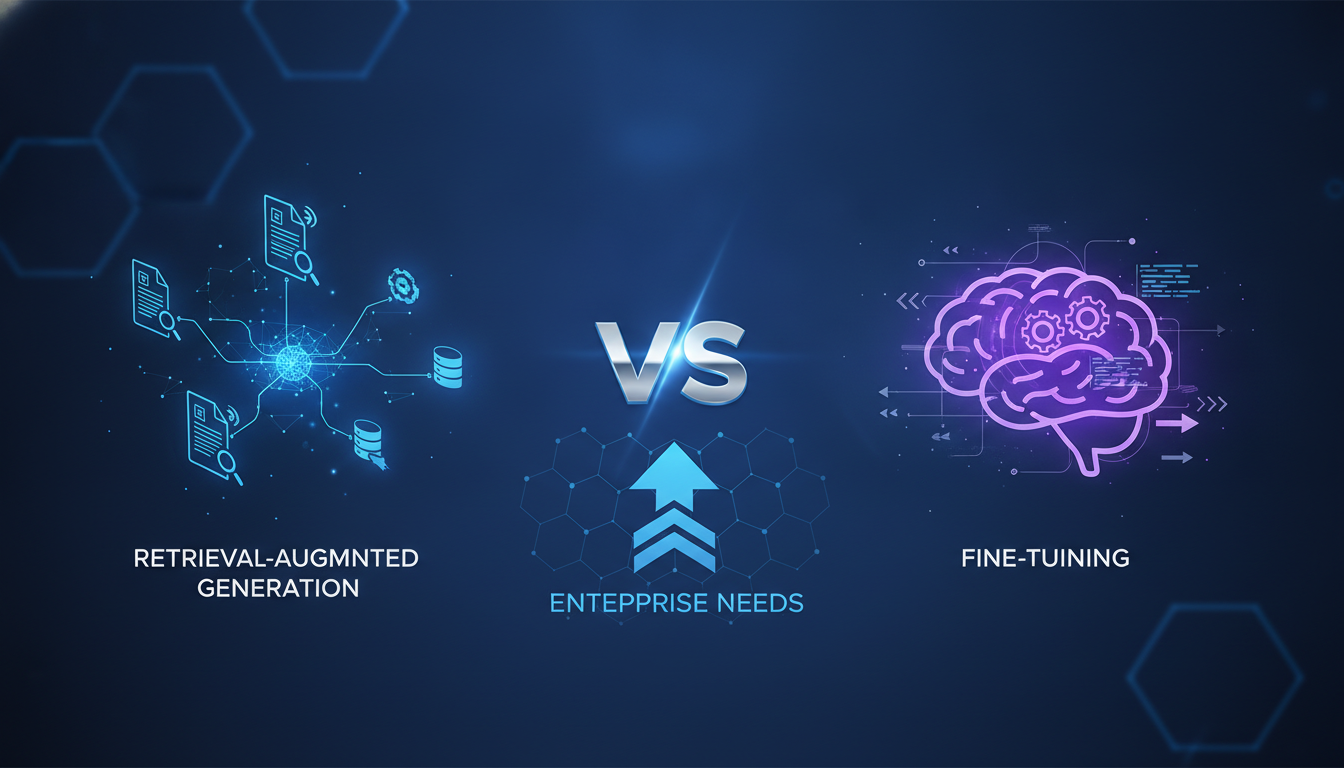
Many leaders ask us the same question. Should our AI look up our documents, or should we train it on our own data? The two options are called retrieval-augmented generation (RAG) and fine-tuning. The right choice depends on your data, your team and the job you want done.
RAG is where the AI looks up your documents before it answers. Fine-tuning is where you train an existing language model further on your own examples, so it gets better at one task.
What is the main difference between RAG and fine-tuning?
RAG finds the right passages in your documents and uses them to write an answer. It can also show where the answer came from. Fine-tuning changes the model itself, using examples from your work. It teaches the model a skill, such as scoring a form or sorting a document.
In short, RAG helps when the AI needs facts that change. Fine-tuning helps when the AI needs to do one task the same way every time.
When does RAG fit?
RAG is a good fit when:
- Your knowledge is spread across many places. Think of support tickets, manuals and shared drives. RAG can search them together. An enterprise software company, for example, can use it over its support history.
- Information changes often. You update the documents, and the answers change. You do not need to train the model again.
- People need to check the answer. RAG can point to the source page, so a reviewer can verify it.
You can read more about our RAG systems work.
One example from our work: RAG search for a national statistics ministry: questions in Hindi, English and Kannada, by voice or text, with citations that link to the exact source page. 490+ legacy statistical tables indexed and queryable in plain language.
When does fine-tuning fit?
Fine-tuning is a good fit when:
- You need steady, accurate output on one task. Examples are scoring, sorting and classifying documents.
- You have good examples. You need consistent, well-labelled data from your own work.
- The task is specific to your business. A general model may not know your way of working.
Learn more about our LLM fine-tuning work.
One example from our work: Competency-assessment platform for an auto-components manufacturer: fine-tuned LLM scoring with 95% inter-rater reliability against expert assessors and 80% less assessment time.
What should you check before you choose?
- Your data. Is it spread across systems and changing often? That points to RAG. Is it a clean set of labelled examples? That points to fine-tuning.
- Your team. Fine-tuning needs good training data and people to test the results. RAG needs well-kept documents and access rules.
- Your goal. Choose by the business result you want, such as faster support or less manual document work. Our document AI and OCR work covers the second case.
- Security. RAG needs strict access control on each data source. Fine-tuning needs safe storage of the training data. If data must stay in your own environment, look at on-premise LLM deployment.
How we approach it
We do not start with the technique. We start with the workflow your team wants to improve. Our forward-deployed engineers work inside your team, look at the real data and test both options on a small scope.
Then we pick the option that fits, or a mix of both. We build it with your people, so they see how it works. At the end we hand it over, with the skills and documents your team needs to run it.
What this means for teams running AI in production
A demo can hide the hard parts. In production, documents change, users ask odd questions and someone must watch quality and cost. RAG needs well-kept sources. Fine-tuning needs fresh examples when the work changes. Plan who owns each task, how you will check answers, and when a person reviews low-confidence results.
Next step
If your team has a RAG or fine-tuning choice in pilot but not in production, book a discovery call.
Saksham Gupta
Founder & CEO, EduBildSaksham Gupta is the founder and CEO of EduBild, which embeds forward-deployed AI engineers with enterprise teams to ship production AI. Ex-Daimler AG; KIT Germany.