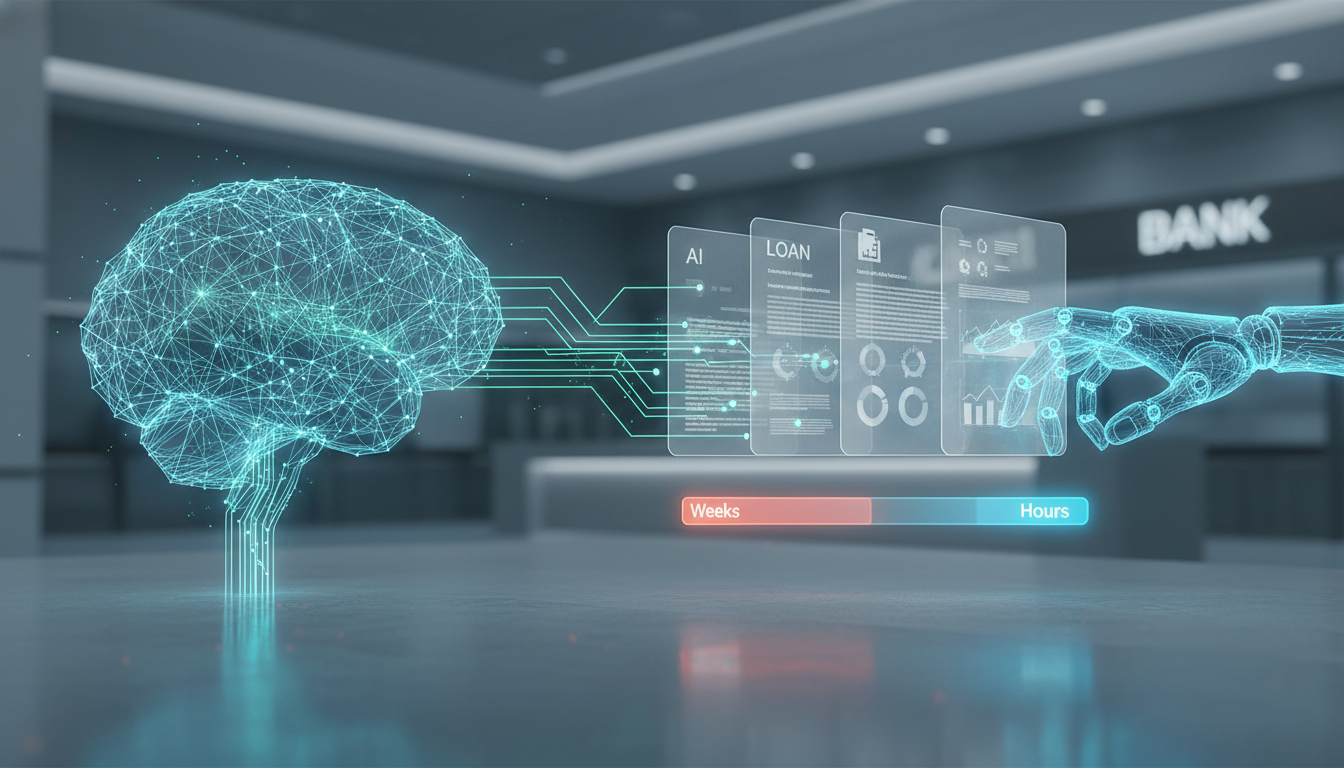
Underwriting delays are a common problem in banking. A loan may need only a few hours of real assessment. Yet approval can still take weeks. The cause is mostly admin, not analysis. Each step waits for the one before it.
Traditional vs. AI-powered underwriting
Traditional underwriting relies on people and runs one step at a time. Documents arrive as PDFs, scans and handwritten forms. Staff must read them and type the data into a system. This is slow and error-prone. Each error can add more delay.
An AI agent is software that can take on a task and carry it out with little human help. Several agents can work at the same time on different steps. They can read messy documents and check data as it arrives. They can also prepare a first risk assessment for a person to review.
The five-stage pipeline and where it stalls
Delays build up in five stages: application intake, document checks, credit and risk analysis, compliance review, and the final decision. Each stage usually waits for the last one to finish. Document checks alone can take days, because each request is sent in turn.
Agents can change this. One agent reads documents while another checks data. A third can start compliance checks. The stages no longer have to queue.
Multiple agents, each with one job
In a multi-agent setup, each agent has a narrow task. One reads documents and pulls out the data. One checks facts with outside sources. One prepares the credit analysis. One checks policy rules. A final step brings the results together for the decision.
Narrow jobs are easier to test and easier to fix. If the document reader makes mistakes, your team can improve that one agent. The rest of the workflow keeps running. For reading scans and forms, document AI and OCR (software that turns scans into usable text) is the usual starting point.
ROI and what changes for your team
The gain is not only speed. Less manual typing means lower handling cost and fewer errors. Borrowers get answers sooner. Underwriters spend more time on hard cases that need human judgment. Your team can handle more applications without adding staff.
Be careful with promised numbers. Results depend on your data, your policies and your starting process. Measure your own baseline first, then compare.
How we approach it
A demo that reads one clean document is easy. Production is harder. It needs your real documents, your credit policy and your compliance reviewers. That is why we work as forward-deployed engineers. We sit inside your team and build with your underwriters, risk staff and IT.
We start by mapping where applications actually wait. Then we build one agent for the biggest delay and test it on real cases. Low-confidence results go to a person. We then add agents step by step. Our process ends with a handover, so your team can run and improve the agents without us.
One example from our work: An autonomous L1 IT support agent that resolves 70% of tickets without a human, around the clock.
That is a different function. It shows the same idea we bring to AI agents in underwriting: agents that run real work in production, not just in a pilot.
Next step
If your team has slow underwriting workflows in pilot but not in production, book a discovery call.
Saksham Gupta
Founder & CEO, EduBildSaksham Gupta is the founder and CEO of EduBild, which embeds forward-deployed AI engineers with enterprise teams to ship production AI. Ex-Daimler AG; KIT Germany.


