Introduction
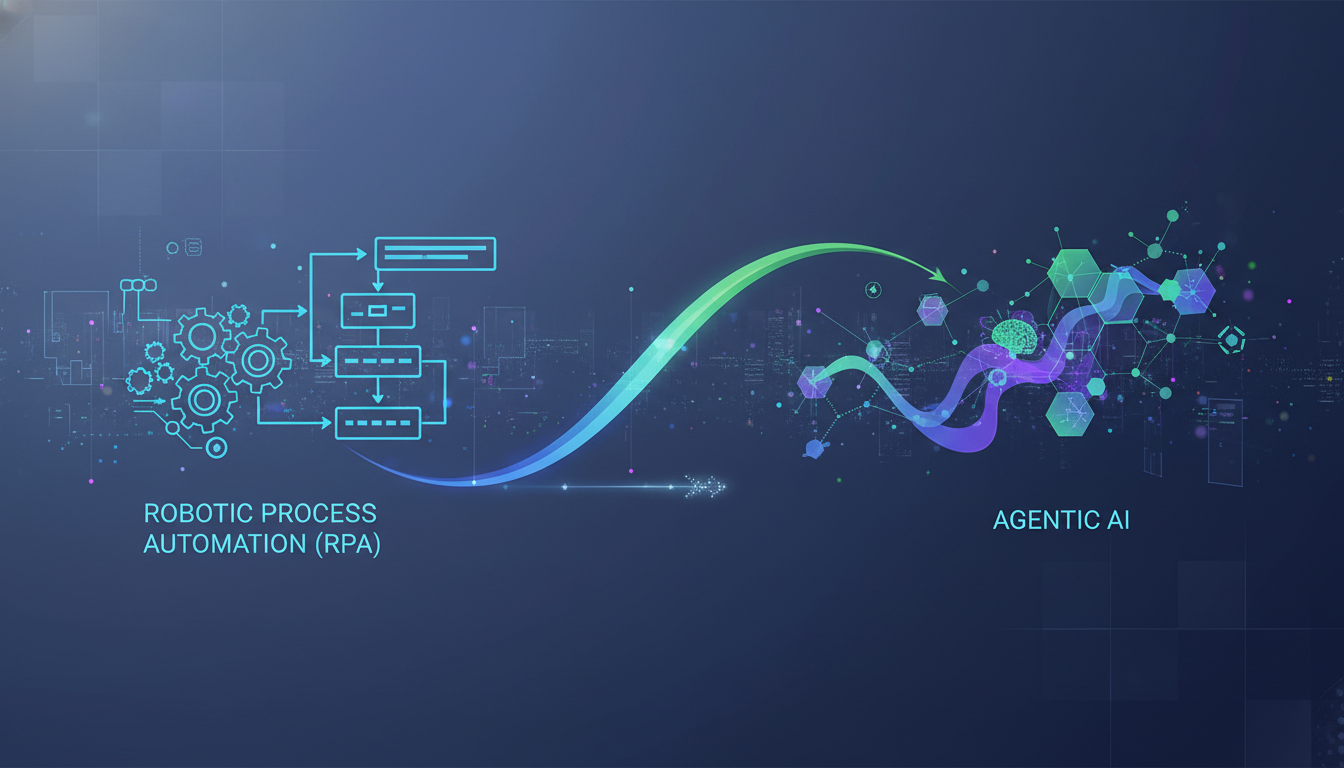
Many enterprises run robotic process automation (RPA), which means software bots that follow a fixed script. Now teams are testing AI agents. An agent works toward a goal and can adapt when things change.
The pilots often look good. Then they stall before they reach production. This article explains the difference between the two, and why the move is harder than a demo suggests.
Understanding RPA and AI agents
RPA follows a fixed script. It works well when tasks are structured and predictable. Payroll runs and bulk data moves are good examples, because the rules rarely change.
But RPA depends on screens and buttons. If a screen changes, the bot can fail. Someone then has to fix the script.
An AI agent is goal-driven. It can read unstructured input, such as invoices in many formats or customer emails. It can also handle cases that do not fit the usual pattern.
Why RPA hits a ceiling
RPA problems grow as you add more bots. Three show up most often:
Fragile screens: a small change in an application can break a script. Maintenance work grows.
Unstructured data: bots struggle with free text, scans and mixed formats. Many cases go back to people.
Exceptions: bots do well on the happy path. Anything unusual needs a human, and queues build up.
Why agent pilots stall in production
An agent can handle messy input in a demo. In production, the questions get harder. Who reviews the agent when it is unsure? What happens when it is wrong? Who watches cost and quality every week?
Take compliance monitoring, where rules change often. An agent could read each update and flag the affected steps. That only helps if people can check its work and switch it off for one team. Without that, the pilot stays a pilot.
Building a hybrid stack
The best ROI often comes from using both. The agent decides what to do and handles exceptions. RPA bots do the work in systems that have no API, meaning no direct way for software to connect.
This keeps the bots you already trust. It adds agents only where bots break down. Our AI agents work follows this pattern.
How we approach it
We do not hand over a slide deck. Our forward-deployed AI engineers work inside your team. They sit with the people who run the process and learn where it breaks.
We start with one workflow, prove it with real data, and then ship it. We add human review for low-confidence answers, a clear on/off switch for each team, and a dashboard to track results. You can see how this runs on our process page.
Then we hand over. Your engineers learn to run, fix and extend the agents. The goal is that your team owns the system, not that you depend on us.
One example from our work: An autonomous L1 IT support agent that resolves 70% of tickets without a human, around the clock.
Deciding when to move
This is not a full replacement. Ask four questions:
- Stability: if a bot runs well, leave it alone.
- Maintenance: if bots break often and take much effort to fix, look at agents.
- Exceptions: if many cases need a human, an agent may help.
- Data: for new processes with unstructured input, start with an agent.
Next step
If your team has an RPA-to-agent workflow in pilot but not in production, book a discovery call.
Saksham Gupta
Founder & CEO, EduBildSaksham Gupta is the founder and CEO of EduBild, which embeds forward-deployed AI engineers with enterprise teams to ship production AI. Ex-Daimler AG; KIT Germany.


