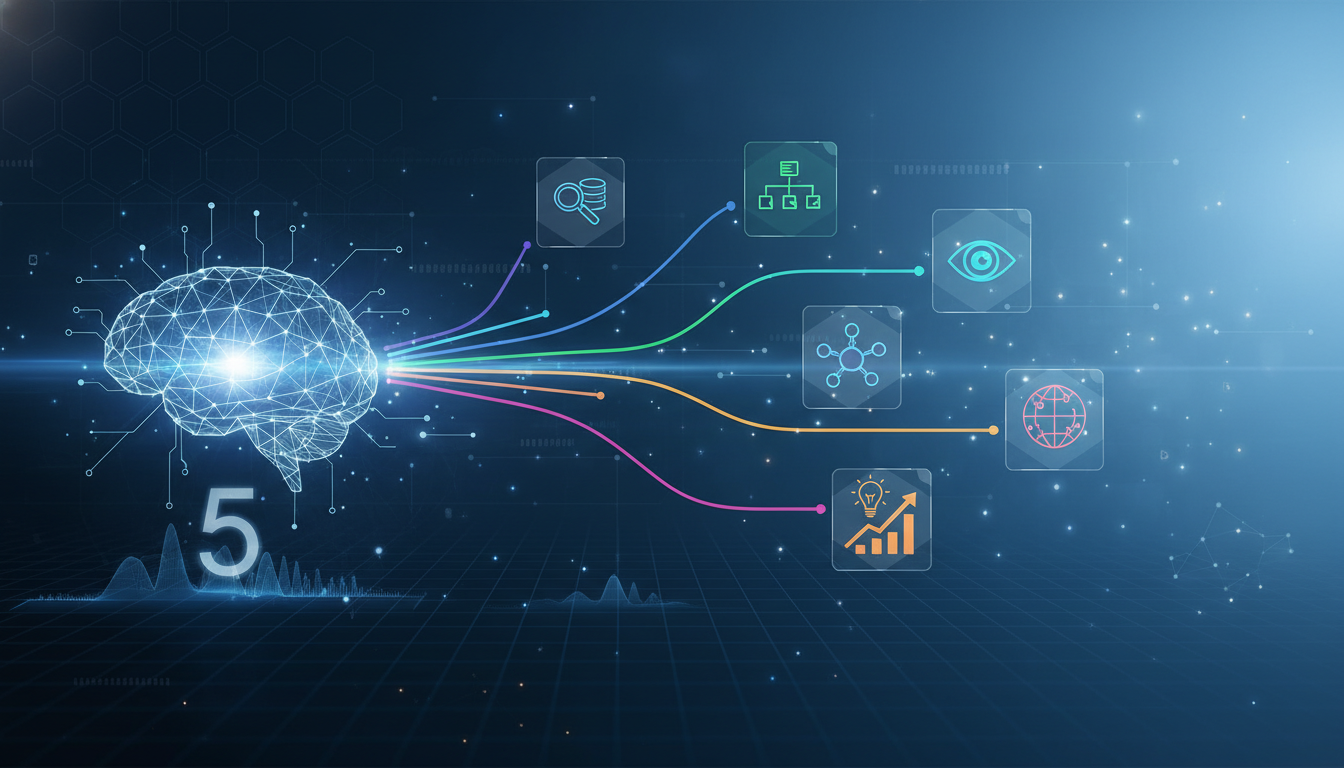
The Growing Need for AI Data Discovery in Enterprises
Most enterprises do not lack data. They have too much of it, in too many places. The hard part is finding the right data quickly enough to act on it.
Older data discovery methods were built for simpler setups. They struggle when data is spread across many systems and teams.
What Is AI Data Discovery?
AI data discovery uses AI to find, label and sort your data for you. It reads the data, notices patterns and suggests what is relevant to a question. It also keeps the descriptions of your data (called metadata) up to date.
Manual methods depend on people tagging data by hand. With AI, data that was hard to find becomes easier to search and use.
Why Older Methods Fall Short
Manual tagging, fixed dashboards and scattered data catalogs take time. They also lead to errors. Teams often cannot tell which data is current or who owns it.
AI can read the data and add context automatically. It can also support search by meaning, so people find what they need without knowing exact file or table names. We do not quote a time-saving figure here, because the gain depends on your data and your workflow.
How AI Data Discovery Speeds Up Insight
The usual path to insight has many steps. A team finds the data sources, asks for access, cleans the data and prepares it. With manual methods this can take weeks.
AI can automate much of the finding, profiling and suggesting. For example, a customer team can spot why customers leave sooner. A finance team can work from data that is easier to find and check.
Benefits, Risks and Trade-Offs
Key benefits
- Speed: Automation cuts manual effort in finding data.
- Scale: AI can cover large amounts of data.
- Fewer errors: It reduces mistakes in labelling data.
- Better control: It can help track where data came from and apply your rules.
Risks and challenges
- Data quality: AI is only as good as the data it reads.
- Oversight: Automated systems need clear owners and review.
- Skill gaps: You need people who know both AI and data work.
- Old systems: Legacy systems may not connect easily.
Trade-offs
- Automation vs control: More automation can mean less visibility into each step.
- Speed vs accuracy: Fast answers still need checking.
- One system vs local freedom: A single shared system can limit what teams do on their own.
How We Approach It
Many data discovery pilots work in a demo and then stall. The tool is not the problem. The problem is that it never becomes part of how a team works day to day. Our process is built to fix that.
We embed forward-deployed AI engineers inside your team. They work with the people who use the data, so the first version fits a real workflow. We start with one workflow, prove it, and then widen it.
We also build for production from the start. That means access controls, human review when the AI is unsure, and clear data owners. At the end, we hand over to your team and teach them to run it. Where answers must come from your own documents, we often use RAG systems, where the AI looks up your documents before it answers.
A Practical Roadmap
Phase 1: Check your data
Look at what data you have, who can reach it and how good it is. Check who owns it.
Phase 2: Fit the platform
Decide how discovery will connect to the systems you already use. Keep metadata up to date.
Phase 3: Add the AI
Use AI for search by meaning and for spotting patterns. Keep improving it with your own data.
Phase 4: Set the rules
Define data owners and access controls. Confirm with your legal and security teams that you meet the rules that apply to you.
Phase 5: Get people using it
Build it into daily work so teams use it. Hand over so your own people can run it.
Next step
If your team has AI data discovery in pilot but not in production, book a discovery call.
Saksham Gupta
Founder & CEO, EduBildSaksham Gupta is the founder and CEO of EduBild, which embeds forward-deployed AI engineers with enterprise teams to ship production AI. Ex-Daimler AG; KIT Germany.


