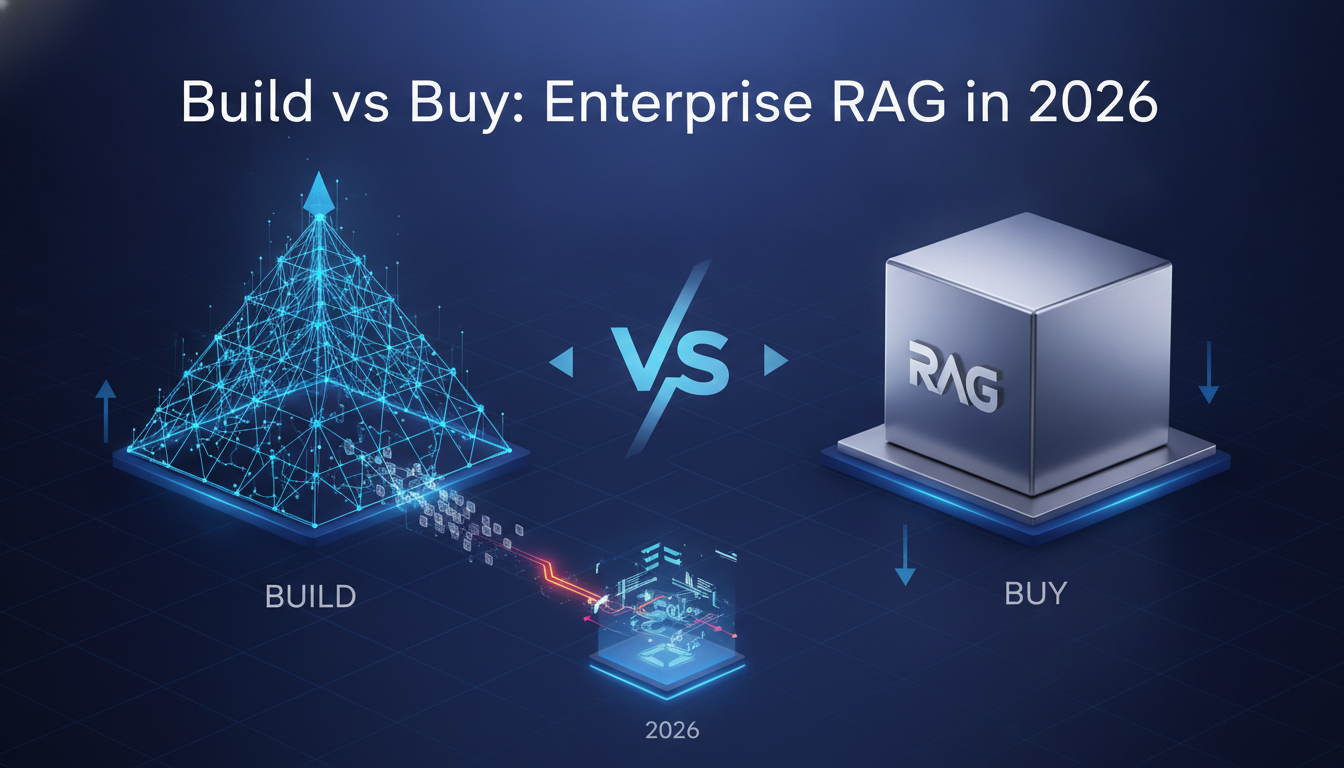
As enterprises increasingly rely on data-driven decision-making, the need for robust Retrieval-Augmented Generation (RAG) systems has never been more pronounced. However, the question remains: should you build your RAG system in-house or purchase a ready-made solution? The decision is crucial, impacting both operational efficiency and long-term scalability.
In 2026, enterprises must weigh the trade-offs between building a custom RAG system and buying an off-the-shelf solution. Building offers customization and control, while buying ensures faster deployment and reduced initial overhead. The choice hinges on your organization's specific needs, technical expertise, and budgetary constraints.
What are the cost implications of building vs buying?
When considering the costs of building versus buying a RAG system, it's essential to look beyond initial expenses. Building a custom RAG system requires a significant upfront investment in skilled personnel, infrastructure, and time. Typically, salaries for AI specialists in India range from ₹15 to ₹25 lakhs per annum, and developing a RAG system could take several months to a year, depending on complexity.
On the other hand, purchasing a RAG system might involve a lower initial cost but includes ongoing subscription fees and potential limitations in customization. Commercial RAG solutions can range from ₹10 lakhs to ₹50 lakhs annually, depending on the provider and scale of deployment. Enterprises should also consider hidden costs, such as integration and potential vendor lock-in. Ultimately, the decision should align with the organization's financial strategy and long-term goals.
How does customization differ between build and buy?
Customization is a significant factor in the build vs buy decision. Building a RAG system allows for full customization to meet specific business needs. This includes integrating proprietary data sources, tailoring the natural language processing capabilities, and aligning the system with existing IT infrastructure.
Conversely, buying an off-the-shelf RAG solution offers limited customization options. While some vendors provide configurable features, these are often constrained by the underlying architecture of the product. For enterprises with unique operational requirements or niche industry needs, building may be the only viable option to achieve the desired level of customization.
What is the impact on deployment time?
Deployment time is a critical consideration when deciding between building or buying a RAG system. Off-the-shelf solutions typically offer faster deployment, often within weeks, as they are pre-built and require minimal configuration. This rapid deployment can be crucial for enterprises needing immediate operational enhancements.
In contrast, building a RAG system in-house is a time-intensive process. It involves stages of design, development, testing, and integration, which can extend the deployment timeline significantly. However, the time invested in building can result in a system that is perfectly aligned with the company's specific needs and future growth plans.
How does control over data security differ?
Data security is a paramount concern for enterprises, especially in sectors handling sensitive information. Building a RAG system in-house provides complete control over data security protocols and compliance measures. Enterprises can implement stringent security practices tailored to their specific regulatory requirements.
Buying a RAG solution involves relying on the vendor's security measures, which may not align perfectly with the enterprise's security policies. While reputable vendors offer robust security features, enterprises must conduct thorough due diligence to ensure compliance with industry standards and local regulations. For organizations prioritizing data sovereignty, building may offer more peace of mind.
What are the scalability considerations?
Scalability is another crucial factor in the build vs buy decision. Building a RAG system allows for scalable architecture that grows with the enterprise's needs. This flexibility can be particularly advantageous for rapidly growing businesses or those anticipating significant data expansion.
Purchased RAG solutions may offer scalability options, but these are often tied to the vendor's infrastructure capabilities and pricing models. Enterprises should evaluate whether these solutions can accommodate future growth without incurring prohibitive costs or requiring complex migrations.
How do vendor relationships impact the decision?
Vendor relationships play a significant role when opting to buy a RAG system. Enterprises become dependent on the vendor for updates, maintenance, and support. This dependency can be a double-edged sword; while it ensures professional support, it also risks vendor lock-in, where switching providers becomes costly and complex.
Building an in-house system mitigates these risks by maintaining autonomy over updates and support. However, it requires a dedicated team to manage ongoing maintenance and improvements. Enterprises must weigh the benefits of vendor support against the potential drawbacks of vendor dependency.
What are the long-term maintenance requirements?
Long-term maintenance is a critical consideration in the build vs buy decision. Building a RAG system requires a dedicated team to manage ongoing updates, bug fixes, and feature enhancements. This can be resource-intensive but offers the advantage of direct control over maintenance priorities.
Buying a RAG solution transfers the maintenance responsibility to the vendor, simplifying operational management for the enterprise. However, this can lead to reliance on the vendor's update schedule, which may not align with the enterprise's operational timelines. Enterprises must assess their capacity to manage maintenance internally versus relying on vendor-provided updates.
What this means for your organization
Deciding whether to build or buy a RAG system involves evaluating your organization's unique needs, resources, and strategic goals. If customization, control over data security, and scalability are top priorities, building an in-house RAG system may be the best path. However, if rapid deployment and lower initial costs are more critical, purchasing a commercial RAG solution might be more appropriate.
At EdubildAI, we specialize in both custom RAG systems and providing support for enterprises choosing to deploy off-the-shelf solutions. Our experience with clients like Cleo demonstrates our capacity to tailor solutions that fit specific enterprise needs. We can help you navigate the complexities of this decision to ensure your RAG system aligns with your organizational objectives.
FAQ
What is a RAG system? A Retrieval-Augmented Generation (RAG) system combines retrieval-based and generative AI techniques to improve the accuracy and relevance of information retrieval from large datasets.
Is building a RAG system more secure than buying one? Building a RAG system in-house allows for tailored security protocols, offering potentially greater control over data security compared to relying on a vendor's security measures.
How long does it take to build a RAG system? The time to build a RAG system varies but typically ranges from several months to over a year, depending on complexity and resource availability.
Closing call-to-action
To explore how EdubildAI can support your enterprise RAG needs, whether through building a custom solution or optimizing a purchased system, contact us today.
Saksham Gupta
Founder & CEOSaksham Gupta is the Co-Founder and Technology lead at Edubild. With extensive experience in enterprise AI, LLM systems, and B2B integration, he writes about the practical side of building AI products that work in production. Connect with him on LinkedIn for more insights on AI engineering and enterprise technology.