In the fast-paced world of enterprise operations, the accuracy of document processing can make or break critical workflows. Imagine a scenario where a single overlooked line item in a financial document leads to compliance issues or financial discrepancies. For enterprises dealing with high-stakes documents, such errors are not just costly—they're unacceptable.
Deep extraction plays a crucial role in ensuring high accuracy in document processing for enterprises. Unlike traditional single-pass extraction methods, deep extraction employs an iterative, agent-driven approach that verifies each extracted piece of information against the source document, ensuring completeness and accuracy. This method is vital for handling complex, high-stakes documents where accuracy is non-negotiable.
Why Do Extraction Pipelines Break on Real-World Documents?
Enterprise document processing often involves handling complex documents with multi-column layouts, nested tables, and embedded data. Traditional single-pass extraction methods struggle with these complexities because they lack a feedback mechanism to catch errors. For instance, a 500-page fund statement may have 1,000 line items, but without a verification loop, the model might consolidate entries or drop records unnoticed. This is problematic when downstream systems rely on accurate data for compliance reports or payment processing.
Single-pass systems treat documents as summaries rather than detailed audits, leading to predictable failure modes. Enterprises need a robust solution that ensures each piece of information is accurately extracted and verified, reducing the risk of costly errors in financial services or insurance claims processing. This is where deep extraction becomes indispensable.
What is Deep Extraction?
Deep extraction is an iterative process that involves sub-agents handling different components of a document, such as line items, headers, and embedded tables. Unlike single-pass extraction, deep extraction includes a verification agent that checks the assembled output against the original document. This ensures that totals reconcile and that extracted data is complete and accurate.
Vision language models (VLMs) are central to this process, enabling the system to read tables and images that text-only models might miss. The orchestration layer atop these models facilitates a verification loop, ensuring accountability and high accuracy. Such architecture is crucial for enterprises where document accuracy directly impacts business outcomes.
When Do You Need Deep Extraction?
Deep extraction is essential for high-stakes documents like financial statements, legal contracts, and regulatory filings. These documents often have more than 50 line items or require cross-document reconciliation. In scenarios where manual review is currently the backstop, deep extraction provides a more efficient and accurate alternative.
For instance, in invoice processing automation, deep extraction ensures that every line item is accurately captured and verified, preventing errors that could lead to payment failures or compliance issues. Enterprises dealing with complex document workflows will find deep extraction invaluable for maintaining accuracy and operational integrity.
When is Standard Extraction Sufficient?
Standard extraction is adequate for short, structured documents with consistent layouts, such as simple invoices or standard forms. In workflows where approximately 95% field accuracy is acceptable and human spot-checks can cover the rest, the additional investment in deep extraction may not be necessary.
The decision to use standard versus deep extraction should be based on the cost of potential errors versus the volume of documents processed. For enterprises, the stakes of inaccuracy often justify the investment in deep extraction, particularly in domains like finance and insurance.
The Architecture Behind Accurate Agentic Document Processing
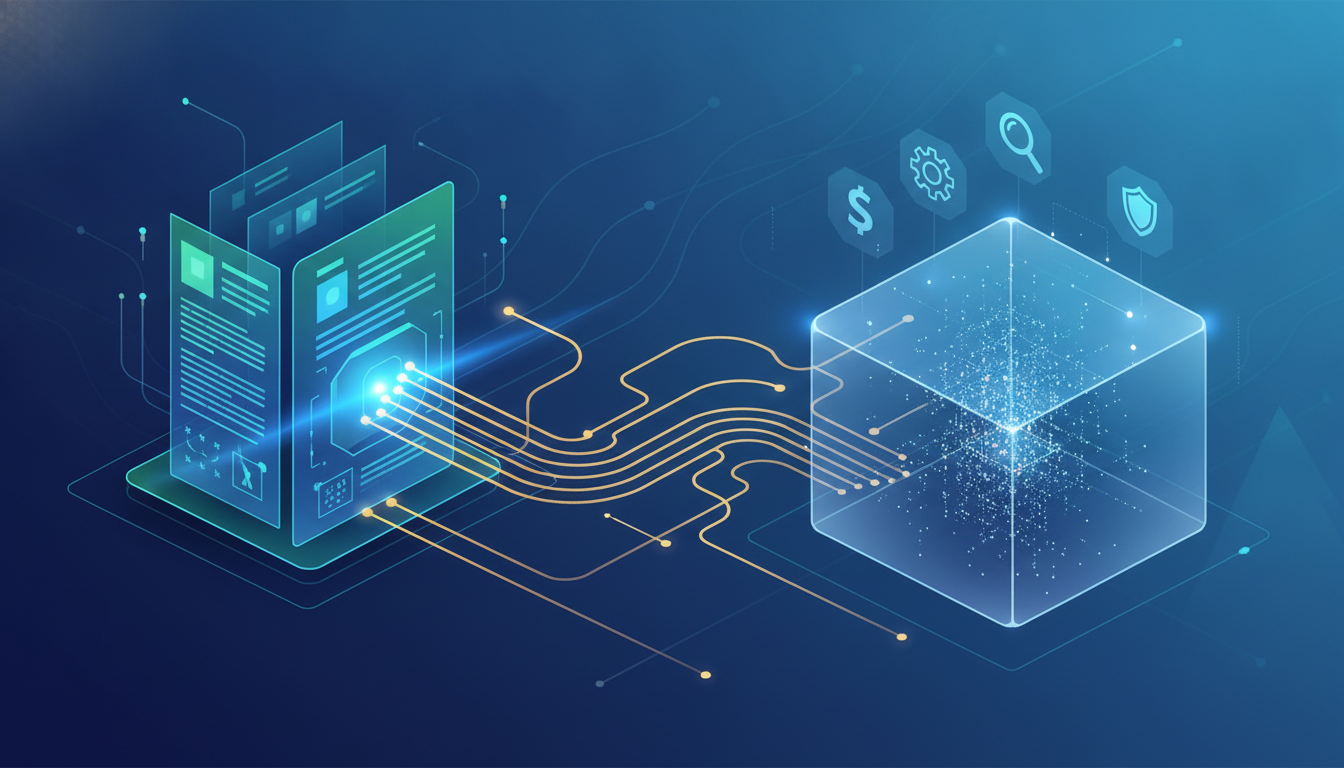
Agentic document processing breaks down documents into verifiable units, separating deep extraction from single-pass pipelines. Sub-agents extract components like line items and totals separately, which are then verified against the source document. This architecture allows for targeted re-extraction of discrepancies without reprocessing the entire document.
Citations and bounding boxes provide verifiability, mapping each extracted field to its source location. This granular approach ensures that enterprises can trace any extracted value back to its origin, crucial for audits and compliance. Moreover, confidence scores and human-in-the-loop touchpoints add layers of explainability and reliability, essential for regulated workflows.
What This Means for Your Organization
For enterprises, implementing deep extraction means more than just improving accuracy—it transforms document processing into a reliable, accountable process. By adopting a deep extraction approach, organizations can eliminate the bottlenecks of manual review and reduce the risk of costly errors in high-stakes workflows.
Investing in deep extraction is an investment in operational efficiency and accuracy. As compliance requirements and document complexities grow, adopting advanced document processing solutions becomes not just advantageous but essential for enterprise success.
FAQ
What is the difference between deep extraction and traditional OCR?
Traditional OCR focuses on converting images of text into machine-encoded text. Deep extraction, however, involves an iterative verification process that ensures each piece of data is accurate and complete, suitable for complex, high-stakes documents.
Is deep extraction necessary for all enterprises?
Not all enterprises require deep extraction. It's most beneficial for those dealing with complex documents where errors have significant downstream consequences, such as financial reporting or regulatory compliance.
How does deep extraction handle complex document layouts?
Deep extraction uses sub-agents to handle different document components and a verification loop to ensure accuracy. This method is effective for complex layouts, ensuring that all relevant data is accurately captured and verified.
Can deep extraction integrate with existing enterprise systems?
Yes, deep extraction can be integrated with existing enterprise systems. Solutions like OCR/document AI can be customized to fit specific enterprise workflows, enhancing accuracy without disrupting existing processes.
Closing Call-to-Action
For enterprises seeking to enhance the accuracy and reliability of their document processing systems, contact us to explore how deep extraction can be integrated into your workflows.
Saksham Gupta
Founder & CEOSaksham Gupta is the Co-Founder and Technology lead at Edubild. With extensive experience in enterprise AI, LLM systems, and B2B integration, he writes about the practical side of building AI products that work in production. Connect with him on LinkedIn for more insights on AI engineering and enterprise technology.