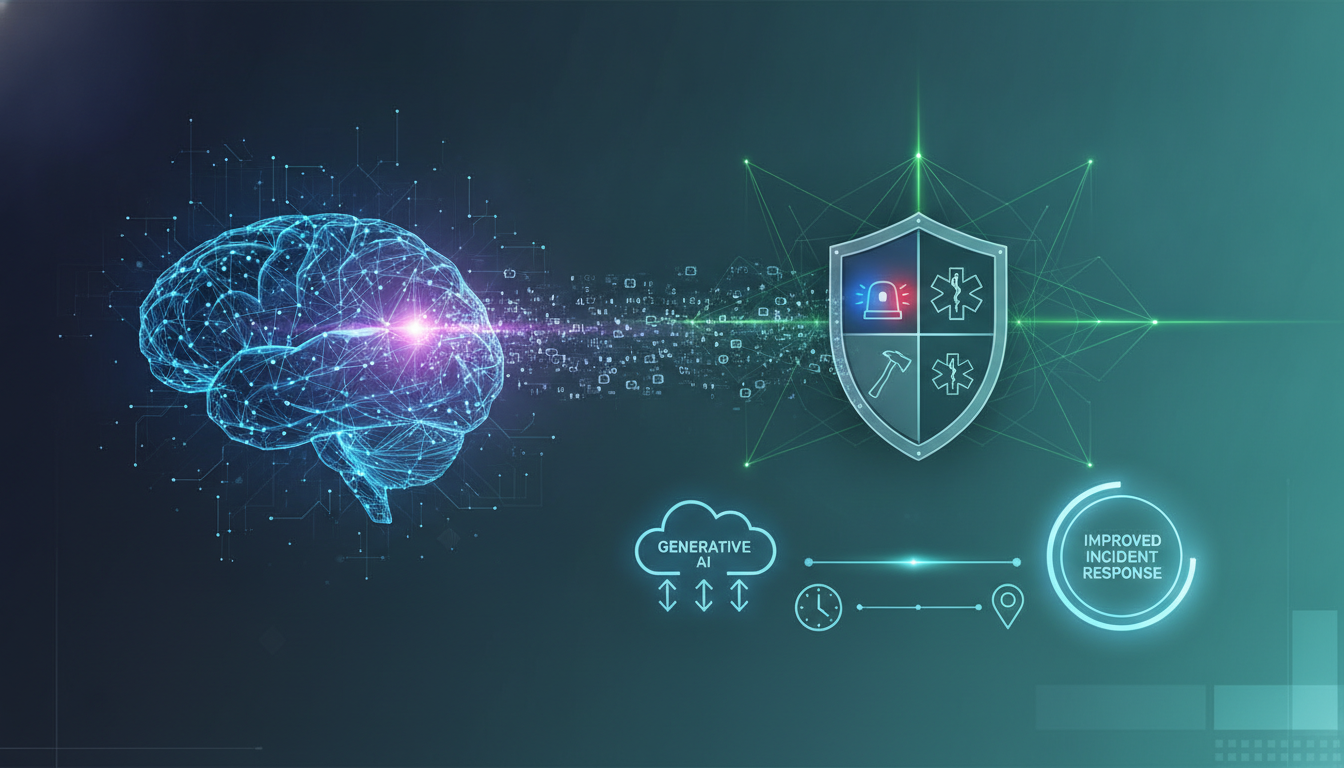
Public safety agencies often grapple with fragmented data systems that hinder their ability to respond swiftly and effectively to incidents. The challenge lies in integrating diverse data sources like NG911, CAD, and RMS to provide a coherent view that supports decision-making in real-time. For enterprises, especially in the public safety sector, leveraging generative AI to unify these data systems can significantly enhance incident response capabilities.
Integrating Generative AI into public safety data systems involves creating a seamless flow of information across all stages of incident management. By connecting disparate systems such as NG911, CAD, and RMS with AI capabilities, responders gain access to real-time intelligence that enhances situational awareness. This integration not only improves the speed and accuracy of responses but also ensures that critical information is readily available throughout the incident lifecycle.
What are the benefits of integrating AI into public safety systems?
Integrating AI into public safety systems offers numerous benefits that enhance the overall efficiency and effectiveness of incident response. Firstly, AI can automate the analysis of vast amounts of data, providing actionable insights to responders. This reduces the time spent on manual data gathering and enables faster decision-making. For instance, AI can quickly analyze previous incidents, risk factors, and address histories to inform current operations.
Furthermore, AI integration enhances communication and coordination among different agencies and departments. By providing a unified platform, it ensures that all parties have access to the same information, reducing the likelihood of miscommunication. This is crucial in high-stakes environments where every second counts.
Additionally, AI can improve predictive capabilities, allowing agencies to anticipate incidents before they occur. By analyzing patterns and trends, AI can forecast potential hotspots and allocate resources more effectively. This proactive approach not only improves public safety but also optimizes resource management.
How does AI enhance situational awareness?
AI enhances situational awareness by providing responders with real-time, contextually relevant information. In a typical public safety scenario, responders need immediate access to data such as the location of the incident, the number of individuals involved, and any potential risks. AI can synthesize this information from various sources and present it in an easily digestible format.
For example, AI-powered systems can integrate data from NG911 calls with CAD and RMS, providing a comprehensive view of the incident. This integration ensures that responders have all the necessary information at their fingertips, enabling them to act swiftly and decisively. Moreover, AI can highlight critical information, such as the presence of hazardous materials or a suspect's criminal history, further enhancing situational awareness.
What role does AI play in decision support?
AI plays a pivotal role in decision support by offering data-driven insights that inform strategic choices. In public safety, decision-makers often face complex scenarios that require quick and accurate judgments. AI systems can process and analyze large datasets to identify patterns and trends that may not be immediately apparent to human operators.
For instance, AI can assist in resource allocation by identifying which units are closest to an incident and assessing their availability. It can also prioritize incidents based on severity, ensuring that resources are deployed where they are most needed. This level of decision support not only enhances operational efficiency but also improves the overall response outcome.
How can enterprises ensure successful AI integration?
Successful AI integration requires a strategic approach that considers both technological and organizational factors. Enterprises should start by conducting a thorough assessment of their existing data systems to identify areas where AI can add value. This involves mapping out all data sources and workflows to ensure seamless integration.
Collaboration with AI specialists is crucial in this process. For example, engaging with experts who have experience in RAG systems or AI agents can provide valuable insights into best practices and potential pitfalls. Additionally, training and change management are essential to ensure that staff are equipped to leverage the new systems effectively.
Implementation considerations
When implementing AI in public safety systems, organizations must consider several factors to ensure success. Data privacy and security are paramount, especially when dealing with sensitive information. Enterprises should implement robust security measures to protect data integrity and prevent unauthorized access.
Scalability is another critical consideration. As the volume of data grows, the AI system must be capable of handling increased load without compromising performance. This may involve deploying on-premise or private LLMs to ensure that the system remains responsive under heavy usage.
Lastly, continuous monitoring and evaluation are essential to assess the effectiveness of the AI integration. Regular audits can identify areas for improvement and ensure that the system continues to meet the evolving needs of public safety agencies.
FAQ
What is the role of AI in NG911 systems? AI enhances NG911 systems by automating data analysis, providing real-time incident insights, and improving dispatch accuracy. This ensures faster and more informed responses to emergency calls.
How does AI integration impact officer safety? By providing real-time intelligence and situational awareness, AI integration reduces the risk of unexpected developments during incidents, thereby enhancing officer safety.
Can AI predict public safety incidents? Yes, AI can analyze historical data to predict potential incidents, allowing agencies to proactively allocate resources and prevent emergencies before they occur.
Integrating generative AI into public safety data systems is a strategic move that can transform incident response capabilities. To explore how EdubildAI can support your AI integration needs, contact us.
Saksham Gupta
Founder & CEOSaksham Gupta is the Co-Founder and Technology lead at Edubild. With extensive experience in enterprise AI, LLM systems, and B2B integration, he writes about the practical side of building AI products that work in production. Connect with him on LinkedIn for more insights on AI engineering and enterprise technology.