In an age where data drives decision-making, enterprises face the challenge of efficiently processing vast amounts of document-based information. Traditional OCR systems, while reliable, often struggle with accuracy and adaptability in complex scenarios. Large Language Model (LLM) OCR architectures promise enhanced capabilities, but understanding their limitations and benefits is crucial for any enterprise looking to implement these technologies effectively.
LLM OCR architectures offer significant advantages, such as improved error rates on complex documents and the ability to process information more contextually. However, they also introduce new challenges, including silent substitutions and omission loops, which can lead to critical inaccuracies in high-stakes documents. Choosing the right architecture—whether OCR-then-LLM post-correction, VLM-native transcription, or agentic orchestration—depends on the specific needs and document types of an enterprise.
How do different LLM OCR architectures impact document processing?
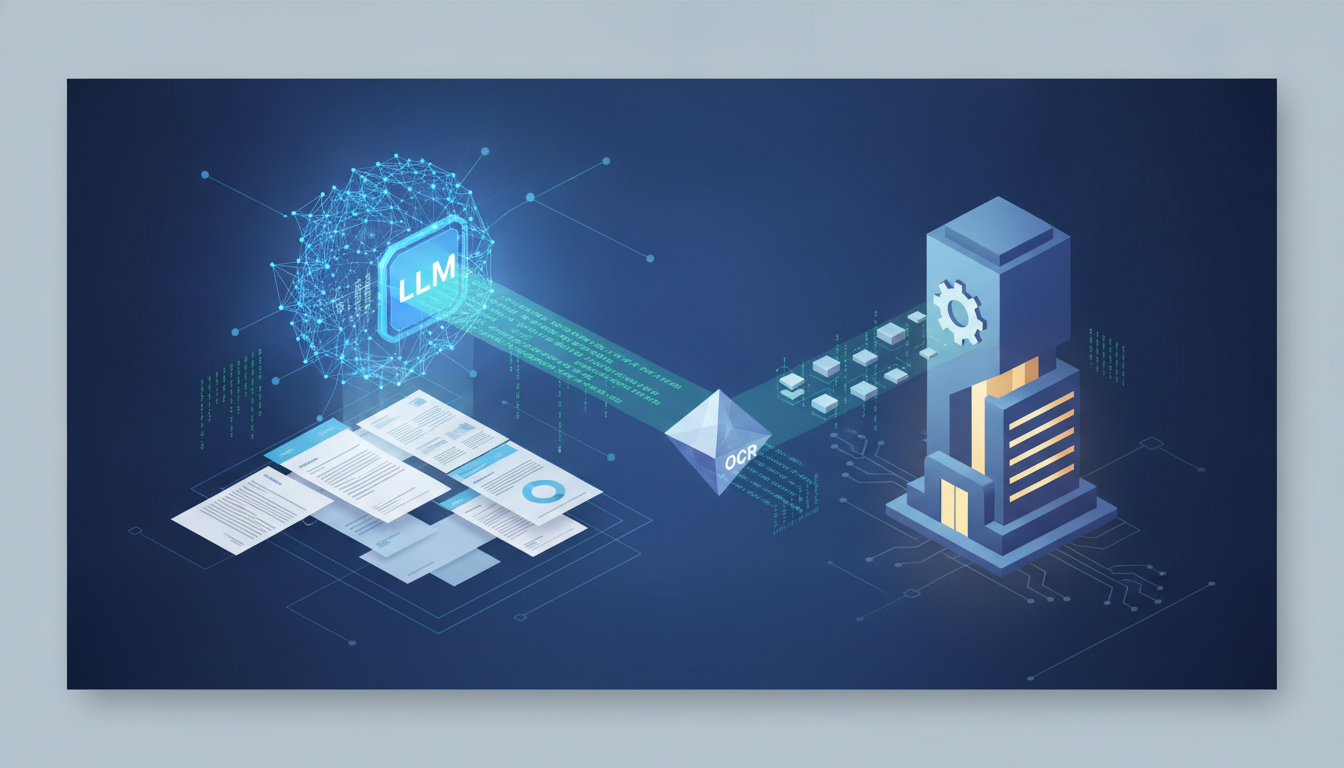
The term "LLM OCR" can refer to three distinct architectures, each with its own set of strengths and weaknesses. The first, OCR-then-LLM post-correction, involves a traditional OCR engine that performs initial character recognition, with a language model subsequently refining the output. This method is popular for its simplicity and ease of integration but can "launder" errors into seemingly correct output that may not reflect the original document accurately.
The second architecture, VLM-native transcription, utilizes vision language models that directly interpret the document image to generate text. This approach eliminates the intermediate recognition step, potentially increasing accuracy for complex layouts. However, without a character-level confidence score, errors can be difficult to detect, particularly when dealing with high-entropy fields like account numbers or part codes.
The third approach, agentic orchestration, involves segmenting a document and routing its components to specialized models for processing. This system-centric method allows for greater flexibility and accuracy, as it can be tailored to handle a variety of document types and complexities. However, it requires substantial infrastructure and coordination, making it a more resource-intensive solution.
Why might LLM OCR errors be more difficult to detect?
Traditional OCR systems provide confidence scores for each character, allowing for easy identification of potential errors. In contrast, LLM OCR systems, especially those using VLM-native transcription, generate text based on the most probable tokens rather than individual glyphs. This token-based approach can lead to "silent substitutions," where unusual but correct values are replaced with more common ones, and "omission loops," where parts of a document are unintentionally skipped.
These errors are often less obvious than those produced by traditional OCR, as the output remains fluent and well-structured. For enterprises, this means that relying on traditional metrics like character error rate may no longer suffice. Instead, field-level accuracy and evidence-based verification become critical to ensure that the extracted data is both correct and complete.
What are the enterprise-specific considerations for LLM OCR deployment?
For enterprises in India and beyond, deploying LLM OCR systems involves weighing the benefits of improved processing against the challenges of integration and error management. Industries dealing with complex documents, such as finance or healthcare, may find the enhanced capabilities of LLM OCR particularly beneficial. However, the risk of undetected errors necessitates robust validation processes.
Enterprises should consider partnering with experienced providers like EdubildAI, which offers tailored solutions such as OCR/document AI and LLM fine-tuning to ensure that the chosen architecture aligns with their specific document processing needs. Additionally, understanding the nuances of each architecture can inform better decision-making and strategic implementation.
What this means for your organization
Implementing LLM OCR requires careful consideration of the specific document processing needs of your organization. Enterprises must evaluate the types of documents they handle, the accuracy requirements, and the resources available for deployment and maintenance. An investment in LLM OCR can lead to significant efficiency gains, particularly for organizations dealing with large volumes of complex documents.
It's important to ensure that the chosen solution is capable of handling the nuances of your documents, such as financial statements, legal contracts, or healthcare records. Partnering with a consultancy like EdubildAI, which has experience in deploying solutions for various sectors, can provide the expertise needed to navigate these challenges effectively.
FAQ
What are the main benefits of using LLM OCR over traditional OCR?
LLM OCR offers improved error rates and the ability to understand context, which can be beneficial for processing complex documents that traditional OCR systems struggle with. However, it requires more sophisticated validation to ensure accuracy.
How can enterprises ensure the accuracy of LLM OCR outputs?
Enterprises should implement robust validation processes, such as field-level accuracy checks and evidence-based verification, to catch errors that traditional metrics might miss.
Are there specific industries that benefit most from LLM OCR?
Industries that deal with complex, high-stakes documents, such as finance, healthcare, and legal sectors, can benefit significantly from the enhanced capabilities of LLM OCR.
For a deeper understanding of how EdubildAI can tailor LLM OCR solutions to your enterprise needs, contact us today.
Saksham Gupta
Founder & CEOSaksham Gupta is the Co-Founder and Technology lead at Edubild. With extensive experience in enterprise AI, LLM systems, and B2B integration, he writes about the practical side of building AI products that work in production. Connect with him on LinkedIn for more insights on AI engineering and enterprise technology.