In an era where data drives decision-making, enterprises face the challenge of extracting structured data from unstructured documents like invoices and reports. Despite their structured appearance, tables in PDFs and scanned documents pose significant hurdles for traditional OCR systems, leading to inefficiencies and potential data inaccuracies.
OCR table extraction is inherently more complex than standard text OCR due to the spatial relationships and structural nuances of tables. To enhance document processing efficiency, enterprises need to adopt advanced OCR technologies that incorporate layout-aware processing and schema-aligned extraction. These systems ensure accurate data retrieval and integration into enterprise applications, improving overall operational effectiveness.
Why is table extraction harder than standard OCR?
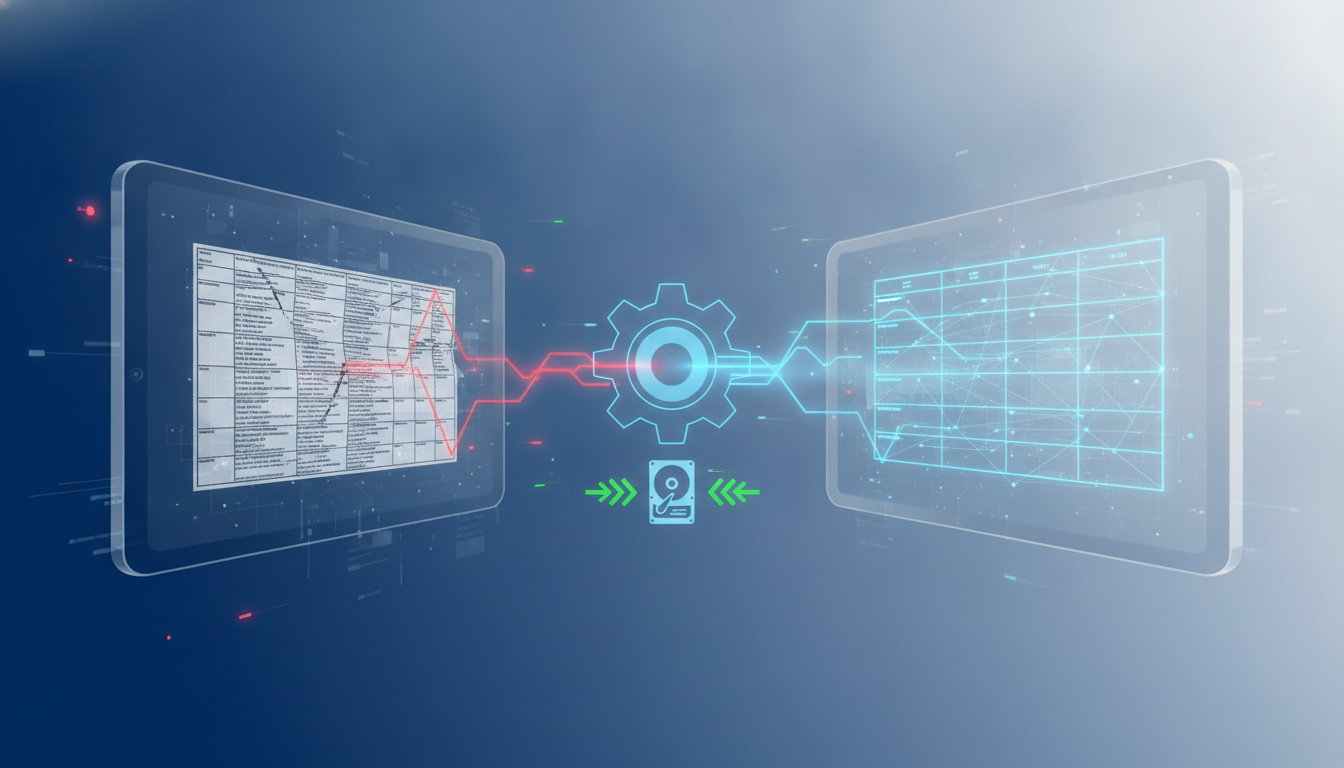
Extracting tables from documents is fundamentally more challenging than extracting text. Traditional OCR systems process text sequentially, while table extraction relies on understanding spatial relationships between data points. For instance, a numeric value only holds meaning when associated with the correct column header and row context. This dependency on spatial relationships can lead to significant errors if boundaries are misidentified, potentially shifting values into incorrect fields, which can corrupt downstream datasets.
Several structural complexities exacerbate these challenges. Merged cells require understanding hierarchical relationships, as a single header might span multiple columns. Similarly, multi-line rows need to be recognized as single entities to maintain logical coherence. Borderless tables, which rely on whitespace rather than visible gridlines, add another layer of complexity, making positional inference difficult for conventional OCR.
What are the core phases of table extraction?
Table extraction involves three critical phases: detection, structure recognition, and data extraction. The detection phase identifies tabular regions within a document using computer vision techniques to analyze alignment patterns and whitespace distribution. Accurate detection is crucial for isolating structured areas from surrounding text.
In the structure recognition phase, the system reconstructs the grid by identifying row boundaries, column divisions, and header hierarchies. This step converts visual information into a logical coordinate system, which is essential for maintaining data alignment. Errors at this stage can lead to significant misinterpretations, even if character recognition is accurate.
The final phase, data extraction, involves applying OCR within each detected cell and mapping values to predefined schema fields. Modern systems incorporate validation logic to ensure data integrity, using arithmetic checks and cross-field consistency rules to prevent errors from propagating into enterprise workflows.
How do modern OCR systems improve extraction accuracy?
Modern OCR systems, like those we implement at EdubildAI, enhance extraction accuracy by using advanced algorithms and machine learning models. These systems are designed to handle complex table structures by incorporating layout-aware processing and schema-aligned extraction techniques. For example, our OCR/document AI services link employ structural parsing to maintain logical integrity, ensuring that multi-line descriptions remain attached to their corresponding rows.
Additionally, systems like LlamaParse demonstrate how integrating validation layers can ensure arithmetic correctness before data synchronization with ERP systems or analytics pipelines. By preserving structural relationships rather than flattening text blocks, these systems enable immediate usability without the need for post-processing scripts.
What are the industry applications of OCR table extraction?
OCR table extraction has widespread applications across various industries. In financial services, it facilitates the accurate extraction of data from invoices and financial statements, streamlining reconciliation processes. Logistics and supply chain sectors benefit from automated extraction of order details from shipping documents, enhancing operational efficiency.
In healthcare, OCR table extraction supports the digitization of patient records and billing information, improving data accessibility and compliance. Each of these industries requires precise data extraction to maintain high standards of accuracy and reliability, underscoring the importance of adopting advanced OCR solutions.
What this means for your organization
For enterprises looking to improve document processing efficiency, investing in advanced OCR table extraction solutions is crucial. These systems enable accurate data extraction, reducing manual errors and enhancing the reliability of integrated data systems. By leveraging EdubildAI's expertise in document AI and OCR implementations, organizations can streamline workflows, improve compliance, and drive better business outcomes.
Implementing these solutions requires careful consideration of the specific document types and data structures your organization deals with. Our tailored solutions, such as on-premise LLM deployment and ERP development, ensure that your unique needs are met, providing a scalable and effective approach to document processing.
FAQ
How does OCR table extraction differ from traditional OCR? OCR table extraction involves understanding spatial relationships and structural nuances of tables, whereas traditional OCR focuses on sequential text recognition. This makes table extraction inherently more complex.
What industries benefit the most from OCR table extraction? Industries such as financial services, logistics, supply chain, and healthcare benefit significantly from OCR table extraction due to the structured nature of their documents and the need for accurate data integration.
How can my organization implement advanced OCR solutions? Organizations can implement advanced OCR solutions by partnering with experienced providers like EdubildAI, who offer tailored services such as document AI to meet specific business needs.
What are the key features of effective OCR systems? Effective OCR systems feature layout-aware processing, schema-aligned extraction, and validation logic to ensure data accuracy and integrity across enterprise applications.
Ready to enhance your document processing capabilities? Contact us at EdubildAI to discuss how our OCR solutions can benefit your organization.
Saksham Gupta
Founder & CEOSaksham Gupta is the Co-Founder and Technology lead at Edubild. With extensive experience in enterprise AI, LLM systems, and B2B integration, he writes about the practical side of building AI products that work in production. Connect with him on LinkedIn for more insights on AI engineering and enterprise technology.