Why Are Enterprises Facing Challenges in RAG Systems?
In today's fast-paced digital world, enterprises are constantly seeking ways to enhance their AI applications, particularly Retrieval-Augmented Generation (RAG) systems. The challenge lies in managing the operational costs and response times while maintaining high efficiency. As AI deployments become more widespread, the demand for cost-effective and speedy solutions is more pressing than ever.
How Semantic Caching Optimizes RAG Systems
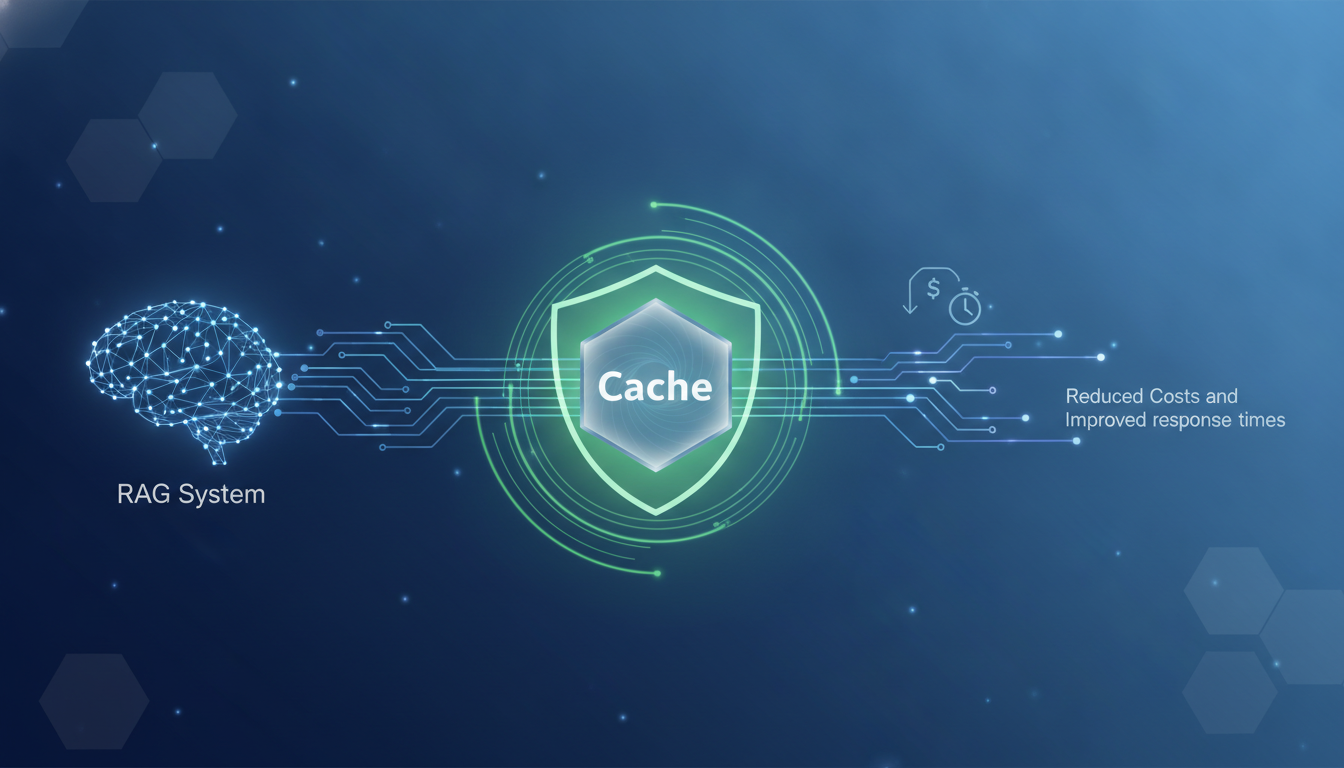
Semantic caching can significantly optimize RAG systems by reusing previously computed responses for semantically similar queries, reducing the need for repeated computations. This not only decreases the latency associated with generating responses but also cuts down on the costs of LLM API calls. By storing and retrieving answers based on semantic equivalence, enterprises can achieve faster response times and more efficient resource utilization.
What is Semantic Caching and How Does it Work?
Semantic caching is a method that enhances data retrieval by storing responses to semantically equivalent queries. Unlike traditional caching, which relies on exact matches, semantic caching considers the meaning of a query. For example, "What is the capital of Brazil?" and "Can you tell me the capital of Brazil?" would retrieve the same cached response. This approach is particularly useful in RAG systems, where the goal is to improve the efficiency of data retrieval from large datasets.
In a typical RAG setup, when a user query is received, it is embedded and searched in a vector database. By implementing semantic caching, enterprises can store common questions and their answers in a key-value format. This allows the system to quickly return a response from the cache when a similar query is encountered, effectively reducing the computational load and improving the system's response time.
How Does Semantic Caching Reduce Costs?
The cost savings associated with semantic caching primarily stem from the reduced need for repeated LLM API calls. Language model APIs, such as those offered by OpenAI, can be expensive, especially when handling high volumes of similar queries. By leveraging a semantic cache, enterprises can avoid redundant computations, thus conserving API usage and lowering operational expenses.
For instance, if hundreds of users ask the same question, the cost of generating a response can be significantly reduced by retrieving a precomputed answer from the cache. This reduction in API calls not only saves money but also frees up resources for other computational tasks, making it a cost-effective solution for large-scale AI deployments.
How Does Semantic Caching Improve Response Times?
Semantic caching directly impacts response times by minimizing the retrieval latency. In traditional RAG systems, each query requires embedding and searching through vast datasets, which can be time-consuming. However, with semantic caching, once a query has been answered, the response is readily available for similar future queries, eliminating the need for repeated data retrieval processes.
This immediate availability of responses makes semantic caching an ideal solution for enterprises looking to enhance user experience by providing quicker answers. By reducing the time taken to process each query, businesses can ensure a more efficient and responsive AI system.
What are the Limitations and Considerations of Semantic Caching?
While semantic caching offers numerous benefits, it is essential to consider its limitations. For applications requiring diverse responses, such as creative text generation, caching might not be ideal as it could limit variation. Semantic caching is most effective in scenarios where queries are consistent and repetitive, such as in FAQ systems or customer support.
Enterprises must also consider the initial setup and maintenance of the semantic cache. Implementing a semantic cache requires a robust understanding of how to manage and store embeddings effectively. Tools like Qdrant can facilitate this process by offering flexible vector search capabilities, essential for implementing semantic caching in RAG systems.
What This Means for Your Organization
Implementing semantic caching in your RAG systems can lead to substantial improvements in both cost-efficiency and performance. By reducing the reliance on expensive LLM calls and speeding up response times, your organization can allocate resources more effectively, providing a better user experience.
For Indian enterprises, where cost management is crucial, adopting semantic caching can provide a competitive edge. By utilizing solutions like EdubildAI's RAG systems and AI agents, businesses can streamline their operations and enhance their AI capabilities.
FAQ
What is the main advantage of semantic caching over traditional caching? Semantic caching focuses on the meaning of queries rather than exact matches, allowing for the reuse of responses for semantically similar queries, which improves efficiency.
How does semantic caching affect the scalability of AI applications? By reducing the computational load and API call frequency, semantic caching enhances scalability, making it easier to manage large volumes of queries efficiently.
Is semantic caching suitable for all types of AI applications? Semantic caching is most beneficial for applications with repetitive queries, such as customer support systems. It may not be ideal for applications requiring unique, varied responses.
What tools can help implement semantic caching? Tools like Qdrant provide flexible vector search capabilities, making them suitable for implementing semantic caching in RAG systems.
For further assistance in optimizing your RAG systems with semantic caching, contact us today to explore tailored solutions for your enterprise.
Saksham Gupta
Founder & CEOSaksham Gupta is the Co-Founder and Technology lead at Edubild. With extensive experience in enterprise AI, LLM systems, and B2B integration, he writes about the practical side of building AI products that work in production. Connect with him on LinkedIn for more insights on AI engineering and enterprise technology.